
Your cart is currently empty!
Blog
January 18, 2024
Blog
How to Learn Gunsmithing With No Experience
January 18, 2024
Plenty of people want to work on firearms but think they need years in a machine shop first. You do not. Gunsmithing is a trade you can start learning from scratch, and most working gunsmiths began as a gun owner who wanted to understand how their firearms came apart and went back together. This guide covers what a gunsmith does, the skills you will build, and how to learn gunsmithing even if you have never picked up a single specialized tool.
What Does a Gunsmith Do?
A gunsmith repairs, modifies and builds firearms. The work combines machinist skills with metalworking. One day can involve fitting a custom barrel and the next can be a simple trigger job or a recoil pad install. Common gunsmithing work includes diagnosing a feeding problem, replacing worn parts, cleaning up a rough trigger, refinishing metal and accurizing a rifle for better groups.
Some gunsmiths handle general firearm repair across many makes and models. Others specialize in one area like custom barrel fitting, metal finishing or building precision rifles for the shooting sports. Both paths start with the same foundation, which is a solid understanding of how firearms work and how to work on them safely.
Do You Need Experience or a License to Start?
You do not need experience to start learning gunsmithing, and you do not need a license to work on your own firearms. That is the simplest way to begin, practicing on guns you already own.
The license question matters once money is involved. If you want to run a gunsmithing business or do repair work on other people’s firearms for pay, you will need a Federal Firearms License from the ATF. You can read the requirements on the ATF federal firearms license page. Understanding firearm legality in the United States is part of the job, so this is worth learning early, even while you are still a student.
Skills You Will Build as a Gunsmith
Working With Hand and Machine Tools
Most gunsmithing starts with basic tools like punches, files, screwdrivers and a quality bench vise. As you take on bigger jobs you move into machine tools, and a milling machine and a lathe become the backbone of serious custom work. Learning to use both hand tools and specialized tools accurately is where a lot of practical skill is built.
Firearm Safety
Every task starts the same way, by confirming the firearm is unloaded and the action is clear. Firearm safety is the first habit a good program drills into you, and it never stops mattering. A gunsmith handles other people’s firearms constantly, so safe handling has to be automatic.
Knowledge of Gun Parts
You cannot fix what you do not understand. A gunsmith learns the parts of pistols, rifles and shotguns, how those parts interact, and what failure looks like. This technical knowledge is what lets you diagnose a problem instead of guessing at it.
Metal Finishing and Machining
Refinishing and machining are where gunsmithing crosses into craftsmanship. Metal finishing protects a firearm and restores its look, while machining lets you cut, fit and shape parts to tight tolerances. These are advanced techniques you grow into over time, not on day one.
Where to Learn Gunsmithing With No Experience
Start With a General Education
A high school diploma or equivalent is the baseline for most gunsmithing programs and jobs. General education in math and basic mechanics helps more than people expect, since measuring, calculating tolerances and reading technical drawings are everyday tasks.
Enroll in a Gunsmithing School or Course
A gunsmithing school gives you structure and a workspace. Programs range from a short gunsmithing course to a comprehensive program that covers design, repair and machining in depth. Many schools offer financial aid, and the course work usually pairs classroom theory with shop time so you build practical skills as you go.
Learn at Home With an Online Program
If an in-person school is not realistic, at-home gunsmithing training is a real option. The American Gunsmithing Institute runs distance-learning courses, and the NRA gunsmithing program offers training as well. A comprehensive course you work through at home will not replace hands-on practice, but it builds the technical knowledge you need before you touch a customer’s firearm.
Get Hands-On Training
Nothing replaces hands-on training. Look for an entry role or apprenticeship at a gun shop or a machine shop, where you work next to someone with real experience. The best experience comes from repetition on actual firearms, so take every chance to disassemble, diagnose and reassemble under supervision.
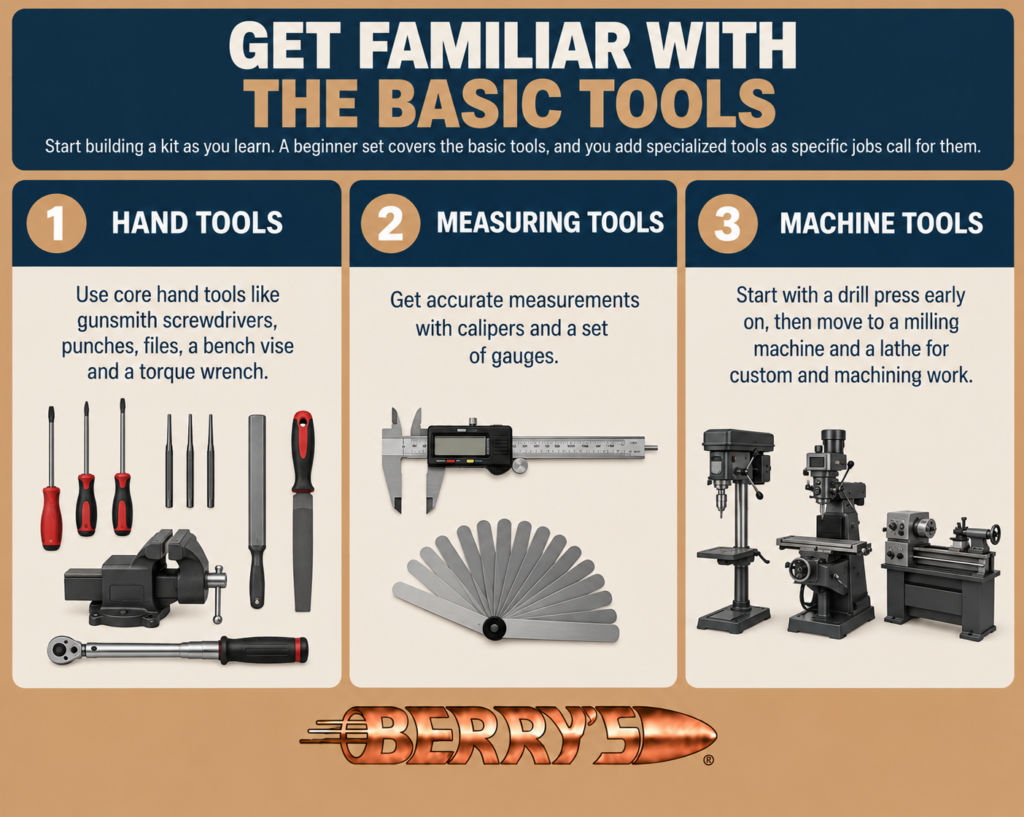
Get Familiar With the Basic Tools
Start building a kit as you learn. A beginner set covers the basic tools, and you add specialized tools as specific jobs call for them.
- Hand tools: gunsmith screwdrivers, punches, files, a bench vise and a torque wrench
- Measuring tools: calipers and a set of gauges
- Machine tools: a drill press early on, then a milling machine and a lathe for custom and machining work
Keep Practicing and Join a Community
Gunsmithing is a trade you improve at by doing. Practice on your own firearms, connect with other gunsmiths, and consider a local gunsmithing club or a shooting sports group. A community gives you feedback, mentorship and a reason to keep pushing your skills forward.
Careers and Opportunities in Gunsmithing
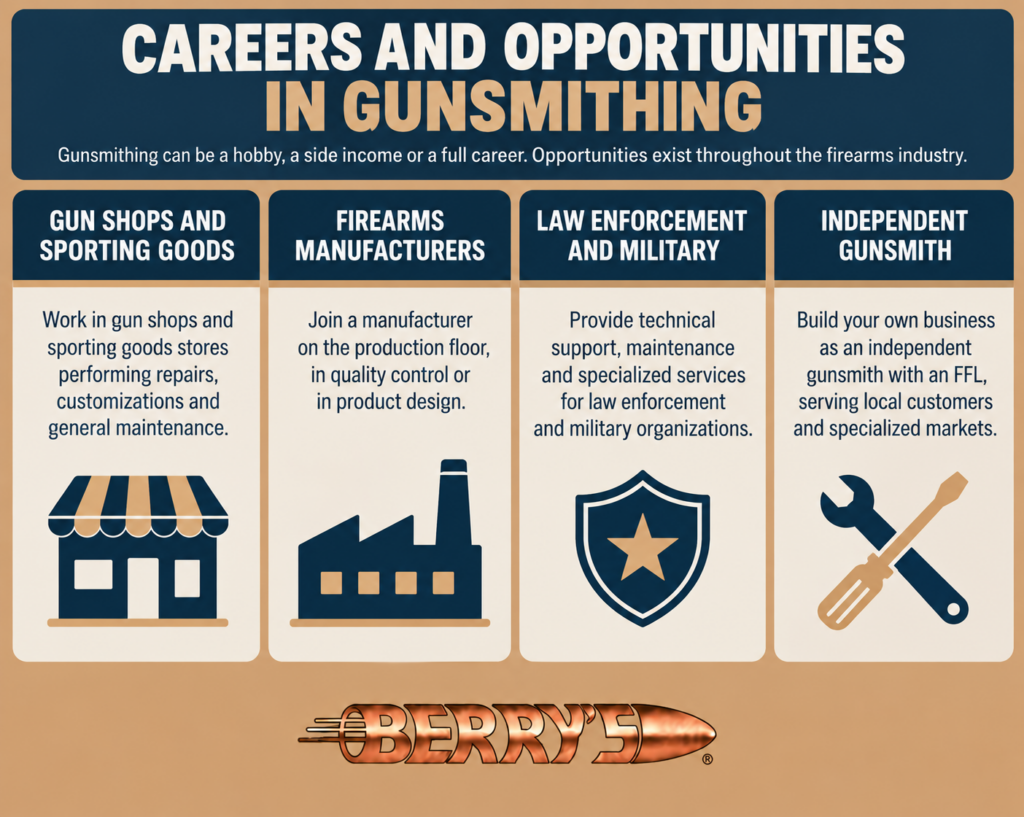
Gunsmithing can be a hobby, a side income or a full career. The demand sits across the whole firearms industry.
Where Gunsmiths Work
- Gun shops and sporting goods stores doing repair and custom work
- Firearms manufacturers on production, quality and design
- Law enforcement and military technical support
- Self-employment as an independent gunsmith with an FFL
Specialize and Advance
As your skills grow you can move toward specialized work like custom barrel fitting, trigger jobs and precision builds. With enough experience and a strong reputation, a gunsmith can reach master gunsmith status, which usually means years of proven work and a deep command of advanced techniques. That career path rewards the people who keep learning and keep refining their craft.
Start Your Gunsmithing Journey With Berry’s
Every gunsmith needs quality tools and components on the bench. Berry’s makes gunsmithing tools built for real shop work, along with superior plated bullets and reloading accessories for the handloading side of the hobby. Everything is made in the United States and built to the same standard the work demands. Set up your bench with Berry’s and start your gunsmithing journey today.
SIGN UP FOR OUR NEWSLETTER