
Your cart is currently empty!
Blog
May 06, 2024
Blog
10mm vs 44 Mag: Caliber Comparison
May 06, 2024
At a Glance: The 10mm Auto and .44 Magnum both serve different roles in handgun performance, but they reach those roles in very different ways. The 10mm runs in semi-automatic pistols with higher capacity and quicker follow-up shots, while the .44 Magnum is a revolver cartridge known for higher energy and deeper penetration. Most shooters choose between them based on firearm platform, recoil tolerance, and how the gun will be used day to day.
Bring up handgun performance in any shop, and the 10mm vs .44 Magnum debate comes up quickly. Both cartridges have proven themselves across a wide range of uses. Neither is universally better. Each simply offers a different balance of power, control, and platform capability depending on the shooter and the situation.
This guide breaks down the 10mm and .44 Magnum across the categories that matter most for real-world use, including recoil, capacity, bullet weight, platform differences, and practical performance. Every point is focused on how these cartridges behave in actual firearms rather than theoretical specifications.
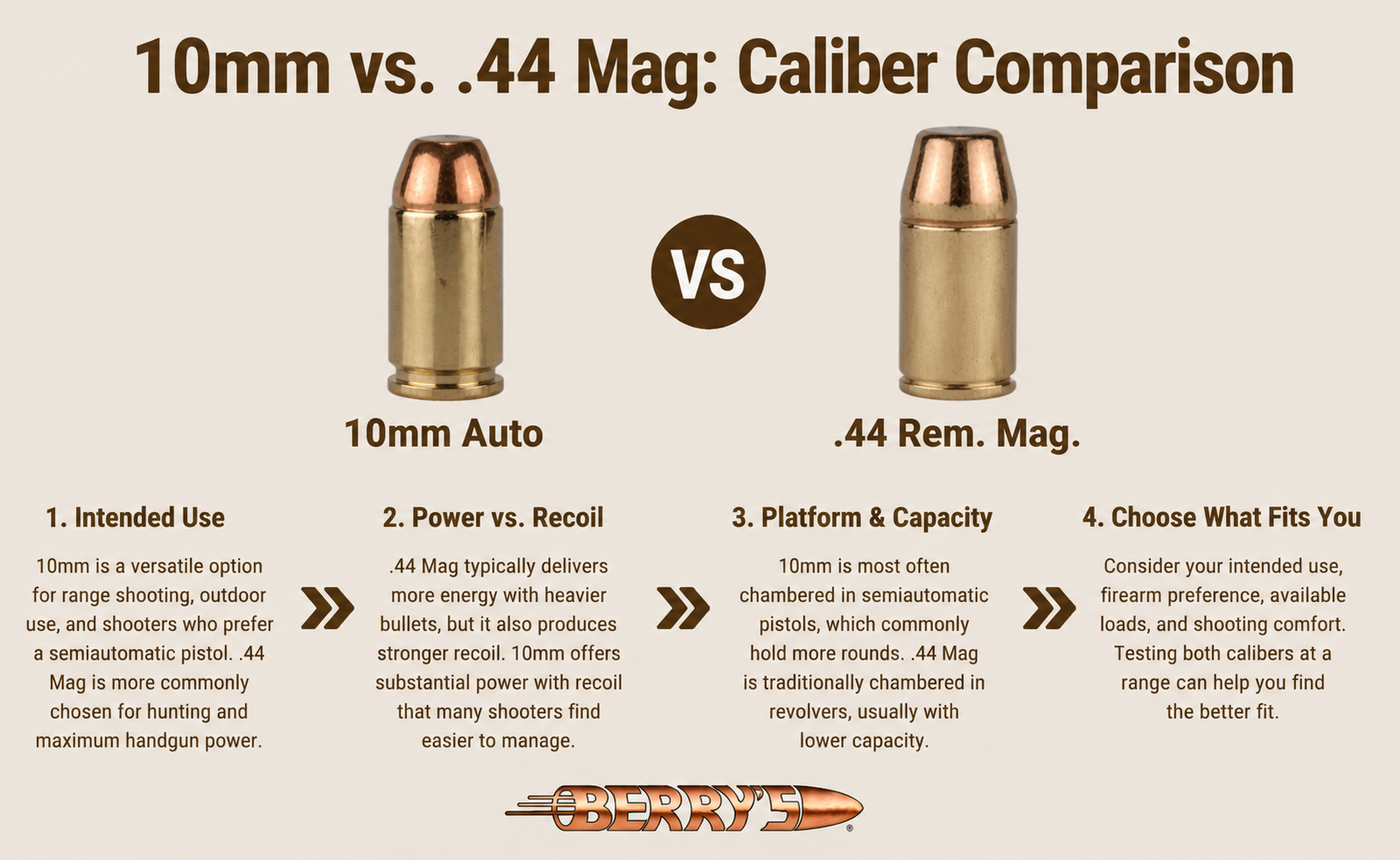
The Two Cartridges at a Glance
Before the head-to-head, it helps to know where each one comes from.
The 10mm Auto arrived in the 1980s as a semi-auto cartridge built to hit harder than a 9mm or .45 ACP. It fell out of favor with law enforcement for a while, then came roaring back with hunters and hikers who wanted magnum-level energy in a flat, high-capacity pistol.
The .44 Remington Magnum showed up in the mid 1950s and quickly became the benchmark for big-bore revolver power. It launched the S&W Model 29 to fame and has spent decades as a trusted round for handgun hunting and bear defense in the largest game country on the continent.
One is a flat semi-auto. One is a heavy magnum revolver. That single difference shapes almost everything below.
1. Stopping Power and Energy
If raw energy decides the contest, the .44 Magnum wins it. A common 240-grain bullet loaded in .44 Magnum ammunition runs well past the energy of a hot 10mm load, and heavier .44 loads stretch the gap even wider. That extra power is why the .44 has a long track record on brown bear, and the biggest animals a handgun shooter is likely to face.
The 10mm is no slouch. A 200- to 220-grain bullet at full power delivers serious stopping power and clearly outruns standard pistol calibers. It sits a step below the .44 Magnum on the energy chart, but for black bear and mountain lion country, it carries plenty of authority.
The short version: the .44 hits harder, the 10mm hits hard enough for most situations, and the difference only becomes a deciding factor at the very top end with the largest bears.
2. Recoil and Muzzle Blast
Power has a price, and you pay it in recoil. The .44 Magnum kicks hard, especially from a shorter barrel where the same load produces sharp recoil and a punishing muzzle blast. New shooters often flinch, and that flinch shows up as missed shots when it matters.
The 10mm is far more manageable. Recoil is firm but controllable, and most shooters get back on target faster. That makes a real difference for accuracy under stress, which is the whole point of carrying a defensive handgun in the first place.
If you can handle the .44 and practice with it often, the recoil is a fair trade for the power. If heavy recoil makes you tense up, the 10mm will likely give you better hits when your heart rate is up.
3. Capacity and Follow-Up Shots
This is where the 10mm separates itself. As a semi-auto, a 10mm pistol like a Glock 20 carries 15 rounds in the magazine, giving you higher capacity and very fast follow-up shots. In a situation where a first hit does not settle things, those extra rounds and that quick recovery matter.
A magnum revolver holds five or six rounds and resets more slowly between shots because of the heavier recoil. A Super Redhawk, a Taurus Tracker, or an S&W model in .44 Magnum gives you fewer chances before a reload, and reloading a revolver under pressure is slower than dropping a fresh magazine.
For follow-up shots and total rounds on tap, the 10mm semi-auto holds a clear edge over the magnum revolver.
4. Bullet Weight, Profile, and Penetration
Against a large, heavy boned animal, penetration is king, and penetration comes from a heavier bullet pushed through a hard, flat nose. This is why hard cast bullets are the traditional field choice for the biggest bears. A heavy, hard cast flat point drives deep and stays on a straight line through bone.
The .44 Magnum has the advantage here because it swings heavier. A 240-grain bullet is the .44 standard, and the cartridge handles even heavier loads for deep penetration on the largest game, including the extreme end of the scale with brown and polar bears.
The 10mm answers with heavy 200 to 220 grain flat point loads that penetrate well for its class, which is a big reason it earned its reputation in bear country in the first place. It will not match the deepest .44 loads, but a stout flat nose 10mm reaches the vitals on most threats a shooter will meet on the trail.
Whichever caliber you choose, match your training bullet to your intended use. That’s where Berry’s comes in.
Our 10mm line ranges up to 220-grain flat points, while.44 caliber includes 240-grain flat point and hollow point options for magnum revolver use. Both are designed for consistent, repeatable load development based on your own published data.
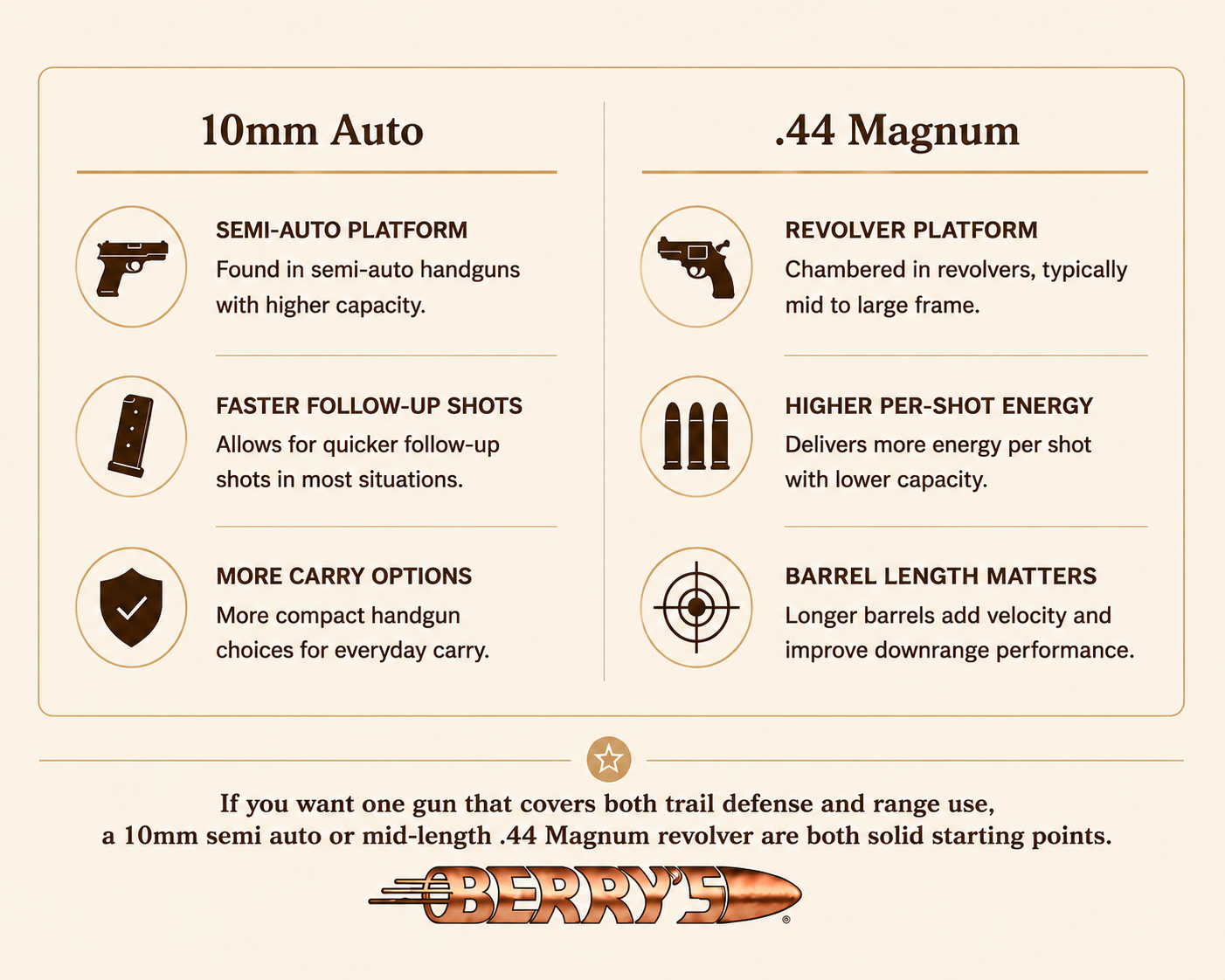
5. Platform and Barrel Length Options
The two calibers also differ in the guns that chamber them.
6. Carrying in Bear Country
The best caliber is the one you actually have on you. A 10mm pistol is lighter and flatter, so it tends to get carried more consistently on long days afield. A full-size .44 magnum revolver is heavier, and the weight that stays in the truck protects no one.
Two more honest notes for bear defense. First, many guides still rank bear spray as the first line of defense, with a handgun as backup, and carrying both is a reasonable plan. Second, shot placement under stress beats caliber on paper every time, which loops right back to recoil, capacity, and practice.
Match the gun to the country. Black bear and mountain lion ground gives the 10mm room to shine on capacity and carry comfort, while serious brown bear country tilts toward the heavier .44 Magnum and its deeper penetration.
7. Practice, Cost, and Building Your Own Loads
The caliber that wins on the spec sheet means nothing if it sits unused because the loaded rounds are too expensive to shoot often. Both 10mm and .44 magnum factory loads cost real money, and bear defense loads in particular are not cheap.
This is the strongest case for reloading. Building your own loads with quality bullets cuts the cost per round, which means more reps and better proficiency with whatever caliber you carry. Heavy recoiling guns demand that practice, so the savings translate directly into shot placement when it counts.
Berry’s Superior Plated Bullets provide an affordable and consistent option for both 10mm and .44 caliber practice loads. The copper plating reduces fouling compared to cast lead and supports clean, repeatable performance when paired with proper load data.
Flat point profiles are commonly used for training and general shooting applications. For reloaders working at the bench, Berry’s bullets are designed specifically for load development using your own published reloading data.
Which Caliber Is the Better Choice for You?
There is no single winner, only the better fit for your needs and your honest personal preference.
Choose the 10mm if you want higher capacity, faster follow-up shots, lighter recoil, easier all-day carry, and plenty of power for black bear, mountain lion, and general personal protection.
Choose the .44 Magnum if you want maximum energy, the deepest penetration, and the proven track record on the largest brown bear and big game, and you are willing to manage heavier recoil and fewer rounds to get it.
Either way, the cartridge only does its job if you can shoot it well, so pick the one you will carry and practice with, then put in the rounds.
Build Your 10mm and .44 Magnum Loads with Berry’s
Berry’s Bullets has been manufacturing reloading bullets and equipment in the U.S. for over 60 years. Whether you are loading practice rounds for a 10mm semi-auto or a magnum revolver, the same principle applies: match your practice bullet to your carry load and shoot it often. Browse our complete range of products for all your reloading needs:
- Superior Plated 10mm Bullets
- Superior Plated .44 Caliber Bullets
- Reloading Accessories
- Ammo Boxes and Cans
For shooters who handload for several calibers, Berry’s full lineup of pistol bullets covers everything from .32 up to .500, in flat point, round nose, hollow point, wad-cutter, and round shoulder profiles, all built on a swaged lead core and electroplated with copper to final weight. Browse Berry’s full lineup of plated bullets to find the right option for your next load.
SIGN UP FOR OUR NEWSLETTER