
Your cart is currently empty!
Blog
April 10, 2026
Blog
45-70 vs 30-30: Caliber Comparison
April 10, 2026
The Short Answer: The 45-70 delivers more power and is the better choice for big game and dangerous game at close range. The 30-30 Winchester offers a flatter trajectory, less recoil, and lower cost, making it the go-to deer cartridge for most hunters. The right pick comes down to what you’re hunting, where you’re hunting it, and how much recoil you want to manage.
The 45-70 and 30-30 are two of the most recognized lever action rifle cartridges in American history. Both are closely tied to the lever gun, both have proven themselves across generations of hunters, and both remain in active production today. That staying power says a lot about what these rifle cartridges can do.
45-70 vs 30-30: History and Background
The 45-70 Government
The 45-70 first debuted in 1873, originally developed for U.S. Army rifles. It started as a black powder cartridge and was later adapted to modern smokeless loads, expanding its performance range significantly. Today it is best known as a big bore powerhouse for black bear, feral hogs, and other large or dangerous game. It pairs particularly well with Marlin lever action rifles and has earned a reputation as a reliable guide gun for hunters in bear country.
The 30-30 Winchester
The 30-30 Winchester was unveiled in 1895 as one of the first American sporting cartridges designed for smokeless powder. Its moderate recoil, flatter trajectory, and compatibility with open sight lever guns made it the dominant deer cartridge in North America for over a century. It works across a wide range of lever action platforms, including the well-known Winchester Model 94, and remains one of the best-selling rifle cartridges in the country.
45-70 vs 30-30: Ballistics
Performance differences between these two calibers come down to bullet weight, muzzle velocity, and what happens to the bullet after it leaves the barrel. Understanding those factors makes the choice much clearer.
Muzzle Velocity and Energy
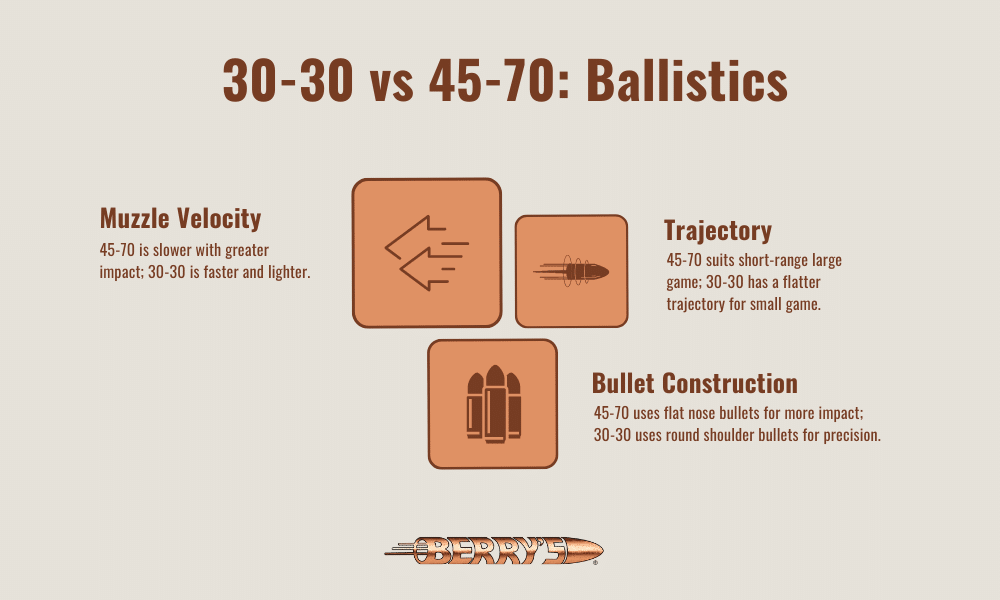
The 45-70 pushes a heavier bullet at slower speeds. Standard factory loads typically drive a 300 to 405 grain bullet at muzzle velocities between 1,800 and 2,000 feet per second. What it gives up in speed it makes up in raw muzzle energy and terminal ballistics on impact. At close range, a 45-caliber cartridge hits with the kind of force that earned it the nickname “freight train” among lever gun shooters.
The 30-30 is lighter and faster. A typical 150 or 170 gr bullet leaves the muzzle at around 2,200 to 2,400 feet per second depending on factory ammo and barrel length. That higher muzzle velocity gives it a flatter trajectory and makes it easier to shoot accurately at moderate distances with open sights.
Trajectory and Bullet Drop
Bullet drop is where these two calibers separate most clearly. The 30-30’s flatter trajectory makes it more forgiving at distance, which covers the majority of whitetail deer shots in wooded terrain. The 45-70 carries more bullet drop at distance, which makes it better suited for shorter range shooting where its power advantage matters most. Typical effective ranges for both cartridges are often cited around 150 to 200 yards, though actual performance varies based on load selection, rifle, and shooter.
Ballistics Comparison
| Factor | 45-70 Government | 30-30 Winchester |
|
Typical bullet weight |
300–405 gr |
150–170 gr |
|
Muzzle velocity |
1,800–2,000 fps |
2,200–2,400 fps |
|
Typical effective range |
~150 yards |
~150–200 yards |
|
Trajectory |
Significant drop |
Flatter |
|
Common use |
Big/dangerous game |
Deer, medium game |
Bullet Construction
The flat nose bullets used in 45-70 factory loads maximize energy transfer on impact, which is part of what makes it effective on large game. The 30-30 traditionally uses a flat nose or round shoulder design as well, driven largely by the tube magazine used in most lever action rifles. Traditional pointed bullets are generally avoided in tube magazines due to primer ignition risk, though modern flexible-tip bullets are specifically designed to be safe in those platforms. Both calibers have benefited from advances in cast bullet and cast lead technology that have expanded their versatility over time.
45-70 vs 30-30: Practical Considerations
Recoil
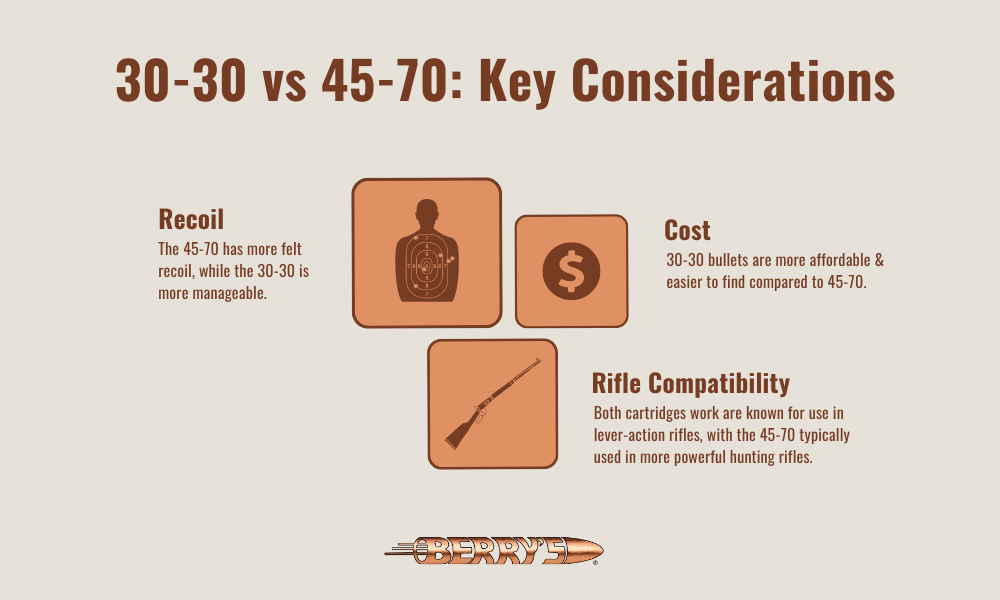
This is one of the most practical differences between the two. The 45-70 produces significant recoil, especially from lighter rifles. A heavy powder charge behind a big bore bullet generates a push that some shooters find manageable and others find punishing. It is not a caliber that rewards flinching.
The 30-30 recoil is much more approachable. Its lighter grain bullet and moderate case capacity make it a comfortable shooter for most people, including beginners picking up a new rifle for the first time. If recoil sensitivity is a factor, the 30-30 is the easier caliber to shoot consistently well.
Cost and Availability
30-30 factory ammo is widely available and generally less expensive than 45-70 across most retailers. That makes it the more budget-friendly option for hunters who shoot regularly or want to practice with the same rifle they hunt with. 45-70 factory loads are available but command a higher price per round and can be harder to find in some markets.
Reloaders have good options with both calibers. The 45-70’s large case capacity gives handloaders significant flexibility in powder charge and bullet weight selection. The 30-30 is also very reloader-friendly and has a long history of cast lead and cast bullet development.
Rifle Compatibility
Both cartridges are most commonly used in lever action rifles, which are the platforms they were designed around. The 30-30 has also been chambered in some bolt-action rifles over the years, such as the Savage 340, though lever guns remain the dominant platform for both. Top lever action manufacturers for both calibers include Marlin, Winchester, and Browning.
- 45-70: Most commonly chambered in larger, heavier rifles designed to handle its recoil. Often the preferred caliber for guide gun builds and bear country carry.
- 30-30: Available in a wider range of lighter, more compact lever guns. A better fit for hunters who want something they can carry all day in the field without fatigue.
Both cartridges can overlap in real-world use depending on load selection and hunting conditions. These are typical use cases, not hard limits.
Choose Your Caliber: A Decision Guide
Choose 45-70 if:
- You hunt black bear, elk, or other large and dangerous game
- Your shots are typically inside 150 yards
- You want maximum terminal ballistics and stopping power
- You reload and want flexibility in bullet weight and powder charge
Choose 30-30 if:
- Deer hunting at moderate distances is your primary use case
- You want a lighter, more manageable lever action rifle
- Recoil is a consideration for you or the shooter using the rifle
- You want affordable, widely available factory ammo
Why Choose Berry’s Bullets
Berry’s manufactures superior plated bullets for both calibers using a process that starts with a swaged lead core and finishes with electroplated copper to exact final weight. That consistency in bullet weight and dimensions translates directly to accuracy at the range and in the field.
Berry’s sells bullets, not loaded ammunition. Here’s what’s available:
- Berry’s 45-70 Bullets: Built for the big bore performance the 45-70 is known for, with consistent construction across every bullet.
- Berry’s 30-30 Bullets: Designed for reliable performance in lever action tube magazines, with the flat nose profile these rifles require.
SIGN UP FOR OUR NEWSLETTER