
Your cart is currently empty!
Blog
April 10, 2026
Blog
300 Blackout vs 5.56: Caliber Comparison
April 10, 2026
The Short Answer: The 5.56 NATO cartridge is the go-to long-range cartridge, delivering a flatter trajectory and higher velocity beyond 300 yards. The 300 Blackout excels in shorter barrels and suppressed builds, offering both supersonic and subsonic ammunition options that make it ideal for close-quarters use and home defense. Choose 5.56 for longer-range shooting and general-purpose use. Choose 300 Blackout for suppressed shooting, a short-barreled rifle, or when you need maximum performance from an AR pistol platform.
The 300 BLK vs 5.56 debate is one of the most common discussions among AR platform shooters. Both calibers are built specifically for the AR-15, but most shooters switch uppers rather than just barrels when moving between them. That shared platform compatibility, combined with their different performance characteristics, makes them natural alternatives when deciding which caliber fits your needs.
The 300 Blackout was developed to address limitations of the 5.56 and the 7.62×39, especially in short-barrel and suppressed applications. That history means these two calibers complement each other rather than compete. Some shooters choose to run both calibers for different applications. The right choice comes down to your specific use case, not which one is objectively better.
300 Blackout vs 5.56: Performance & Ballistic Characteristics
Velocity and Range Performance
The 5.56 NATO pushes lighter bullets at higher velocity. From a standard 16-inch barrel, 5.56 rounds typically reach muzzle velocities between 2,700 and 3,200 feet per second, depending on bullet weight and load. Its higher velocity and flatter trajectory make 5.56 easier to shoot accurately past 300 yards.
The 300 Blackout presents a more complex picture. Supersonic loads reach 1,900 to 2,400 feet per second. Subsonic rounds operate around 900 to 1,050 feet per second. The tradeoff is intentional. The 300 BLK round was designed to maximize effectiveness at shorter ranges where raw velocity matters less than bullet weight and terminal performance.
Barrel Length Performance
One of the biggest differences between these two calibers shows up with shorter barrels. The 5.56 performance is influenced by velocity, though modern bullet designs improve effectiveness across a wider range of barrel lengths than older FMJ loads allowed.
The 300 Blackout was specifically designed for optimal performance in shorter barrels. It maintains consistent terminal ballistics even in AR pistol configurations with barrels as short as 9 inches. That makes it the better-suited caliber for SBR and pistol brace builds where a shorter barrel is part of the platform.
Subsonic Performance and Suppressor Use
The 300 Blackout was designed to support both supersonic and subsonic loads, though reliability with subsonic ammo can vary depending on gas system length, buffer weight, and ammo choice. Many setups require tuning to cycle subsonic rounds consistently. Subsonic 5.56 generally does not cycle reliably in standard AR platforms at all.
The 300 Blackout is generally better suited for suppressed shooting, especially with subsonic loads. A suppressed 5.56 stays supersonic, which limits how much sound reduction you can actually achieve. Subsonic 300 Blackout can be significantly quieter than suppressed 5.56, making it a more practical quiet round for suppressed builds.
Terminal Performance
The 5.56 performance is influenced by velocity, though modern bullet designs, including open-tip match and bonded projectiles, improve effectiveness across a wider velocity range than early FMJ assumptions suggested.
The 300 Blackout uses a heavier bullet that holds terminal effectiveness at lower velocities. That makes it a better fit for medium-sized game at shorter distances with the right load. State regulations, bullet selection, and game size all factor into whether it’s appropriate for a given hunting situation. The 5.56 is better suited for varmint hunting and precision shooting at distance. When compared to the 30-30 Winchester, the 300 Blackout fills a similar niche for medium-range hunting but from a modern AR platform.
300 Blackout vs 5.56: Specialized Applications
Home Defense and Close-Quarters Use
The 300 Blackout is built for short-range performance. It handles tight spaces better because a shorter barrel does not compromise its terminal ballistics the way it does with 5.56. For home defense in a confined environment, that consistency matters.
The 5.56 is still effective at close range, but barrel length becomes a bigger factor in self defense situations where a short-barreled rifle or AR pistol is part of the setup.
Hunting Applications
These calibers serve different hunters.
- 5.56 works well for small game and varmint hunting. Its flat trajectory and high velocity make it accurate at distance.
- 300 Blackout can be used for medium-sized game at shorter distances with the right load. It is a popular choice as a hog hunter round where shots are typically taken inside 150 yards.
- Subsonic 300 Blackout loads also reduce muzzle blast in areas where noise is a concern, giving hunters additional flexibility.
Law Enforcement and Special Operations
The 300 Blackout gained traction with law enforcement and special operations units partly because it was developed by Advanced Armament Corporation (AAC) alongside Remington Defense. The AAC Blackout designation comes from that development history. Its ability to cycle reliably through suppressed short-barrel rifles made it practical for units that need a quiet round without switching to a different platform or caliber bullet entirely.
The 5.56 remains the standard NATO cartridge used widely by law enforcement and military units globally. Its proven performance, widespread availability, and lower cost per round make it the default choice for high-volume use cases.
300 Blackout vs 5.56: Practical Considerations
Cost and Availability
5.56 holds a clear advantage in cost and availability. As a NATO-standard cartridge, it benefits from large-scale military and law enforcement production across every different manufacturer. That keeps prices competitive and supply consistent.
300 Blackout ammunition typically costs more per round and can be harder to find depending on market conditions. If you plan to shoot high volume, that cost difference adds up quickly. Reloaders can offset some of that cost, but it is a real consideration when comparing the two calibers.
Platform Adaptability
Both calibers run on the standard AR-15 platform. Switching between them typically means swapping the upper assembly rather than just the barrel. The lower receiver, magazine, and bolt carrier group stay the same, but it is worth noting that mixing 300 Blackout and 5.56 magazines is a real safety risk. The cartridges look similar enough that accidental chambering is possible and dangerous.
When building a dedicated BLK upper, verify proper headspacing and gas system function before running the first round through it. The 300 Blackout’s compatibility with standard AR-15 components makes it one of the more practical caliber conversions available.
Performance Trade-offs at a Glance
| Factor | 5.56 NATO | 300 Blackout |
|
Effective range |
300+ yards |
Under 200 yards |
|
Barrel length sensitivity |
High |
Low |
|
Suppressor compatibility |
Limited |
Good |
|
Subsonic capability |
Poor |
Good with proper setup |
|
Ammo cost |
Lower |
Higher |
|
Medium game hunting |
Limited |
Suitable with right load |
Choose Your Caliber: A Decision Guide
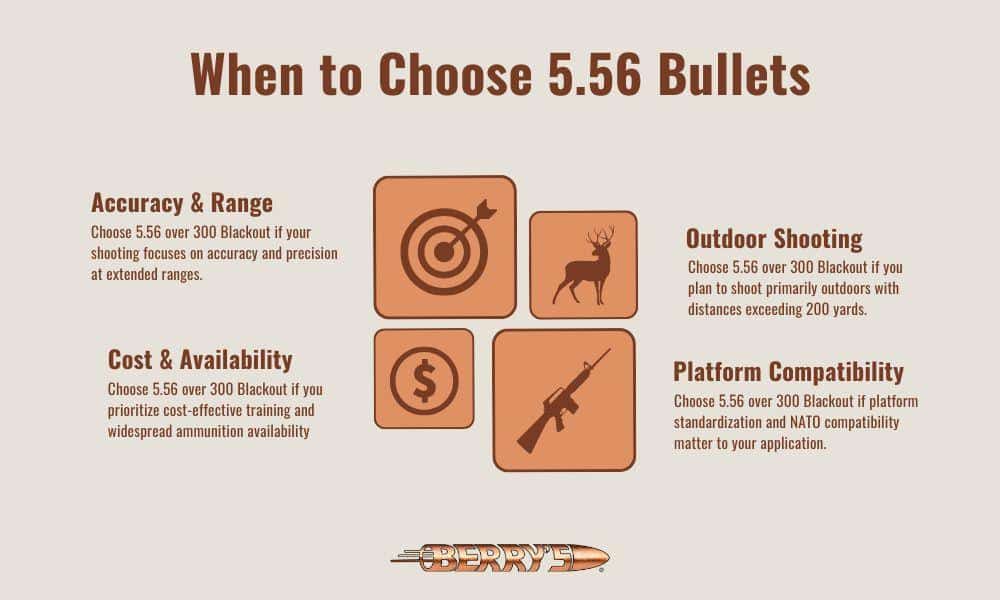
Choose 5.56 if:
- Your shooting focuses on accuracy and precision at extended ranges
- You prioritize cost-effective training and wide ammo availability
- You plan to shoot primarily outdoors at distances past 200 yards
- NATO compatibility and platform standardization matter to your application
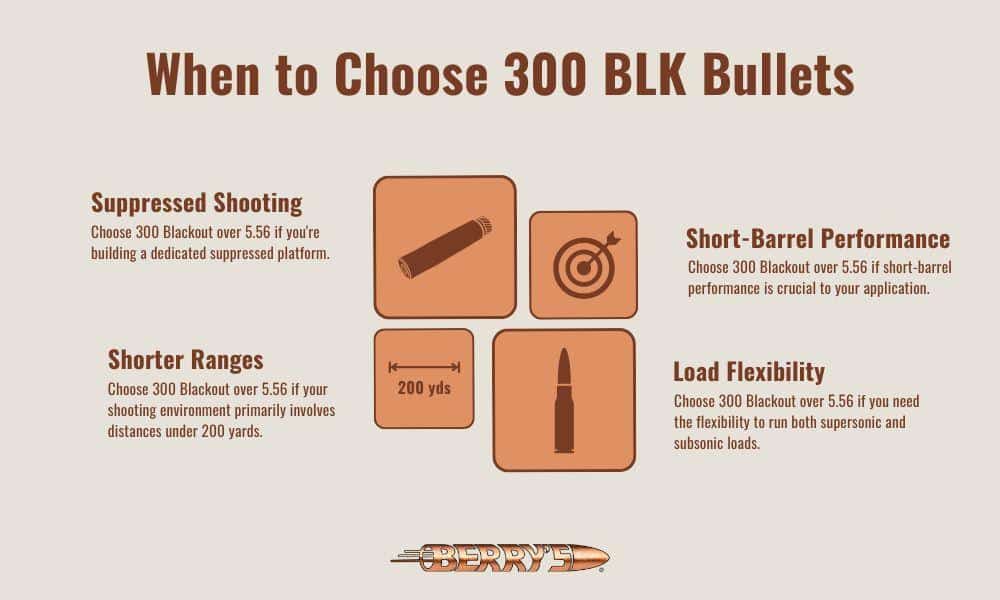
Choose 300 Blackout if:
- You’re building a dedicated suppressed platform
- Your shooting environment involves distances under 200 yards
- Short-barrel performance is a priority for your SBR or AR pistol build
- You need the flexibility to run both supersonic and subsonic loads
The AR platform’s versatility means some shooters choose to run both calibers for different applications. Running the same lower with two different uppers gives you flexibility across a wide range of shooting scenarios without having to learn an entirely new platform.
Personal Preference Matters
Shooting accuracy matters more than caliber selection. The better choice is the one you shoot most consistently and confidently. Ballistics, cost, and personal preference all factor into that decision, but the shooter behind the rifle is always the bigger variable.
Why Choose Berry’s Bullets
For both 5.56 and 300 Blackout builds, bullet selection directly affects performance. Berry’s manufactures superior plated rifle bullets using a precision process that starts with a swaged lead core and finishes with electroplated copper to reach exact final weight. That process produces consistent dimensions and weight across every bullet, which translates directly to accuracy.
Berry’s sells bullets, not loaded ammunition. Here’s what’s available for these two calibers:
- Berry’s 5.56 Bullets: Jacketed boattail bullets built for aerodynamic efficiency. They hold velocity well and work across a wide range of loads when loaded in 5.56 ammunition.
- Berry’s 300 Blackout Bullets: Available in four grain weights to cover both supersonic and subsonic applications. That range of bullet weight options lets reloaders dial in their loads for specific purposes, from suppressed subsonic builds to supersonic hunting loads.
SIGN UP FOR OUR NEWSLETTER