
Your cart is currently empty!
Blog
May 07, 2026
Blog
.357 Magnum vs .38 Special: Choosing the Right Revolver Cartridge
May 07, 2026
The Short Answer: Pick the .357 Magnum for hunting, lever gun use, and full-power defensive shooting. Pick the .38 Special for concealed carry, target shooting, and a softer-shooting experience overall. Both fire the same .357 bullet diameter projectile, so a single supply of Berry’s plated bullets reloads either round.
Few cartridge pairs in American shooting history are as connected as these two. The .38 special cartridge came first, introduced by Smith & Wesson in 1898 as a smokeless powder replacement for the older .38 Long Colt that had been carried into the black powder era. American police agencies adopted it immediately, and it sat in standard issue holsters across U.S. law enforcement for the better part of the next century. The .357 Magnum arrived in 1934 as the answer to a problem the .38 Special could not solve. Elmer Keith, Phillip Sharpe, and Douglas Wesson built it on the same parent case, just longer and loaded to higher pressure to push velocities the original cartridge was never designed for.
About the .357 Magnum
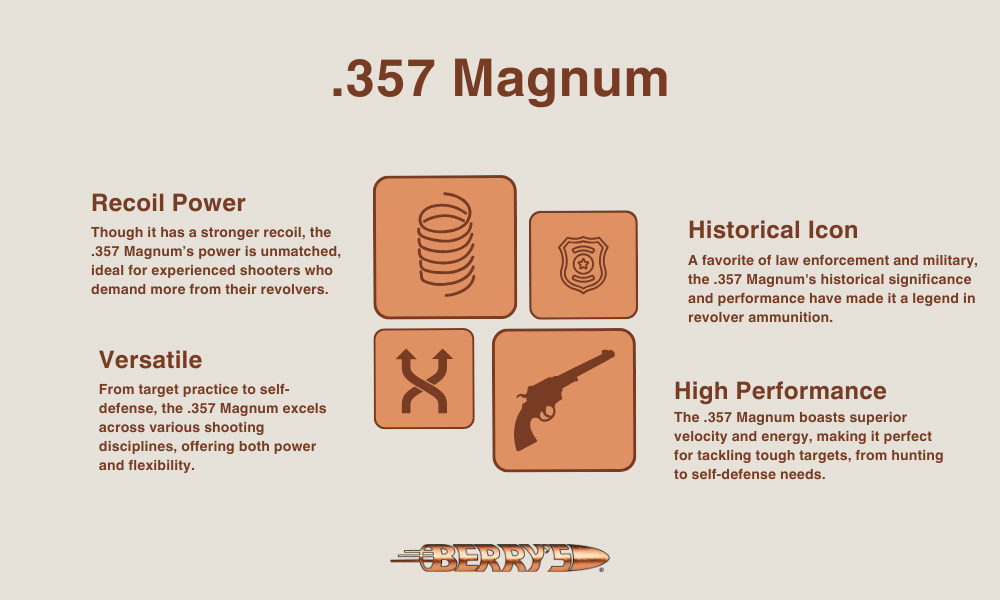
The .357 Magnum sits among the most respected revolver round designs ever produced. It hits with real authority at close range, scales well from short-barreled revolver platforms up to lever action rifles, and remains a top pick for handgun hunters and defensive shooters who want magnum-level performance.
Specs and Performance
The cartridge sends a .357 bullet diameter projectile down a longer mag case measuring 1.29 inches. Overall cartridge length runs 1.59 inches, with a max pressure of 44,000 PSI and case capacity around 26.2 grains H2O. Although the .357 shares the same case head as the .38 Special, the longer magnum case keeps it from chambering in a .38 Special revolver. The “magnum” name does not mean a larger bullet either, just the same .357 diameter projectile pushed harder by more powder and more pressure.
Ballistic Performance
.357 Magnum velocities typically run between 1,200 and 1,500 fps depending on bullet weight, load selection, and barrel length. Average velocity from a 4 inch barrel sits in the middle of that range, with energy figures from roughly 539 to 783 ft-lbs. Stretch the same load into a longer barrel lever gun and the cartridge picks up another few hundred fps, opening up its hunting use considerably.
Applications
The .357 Magnum earns its reputation across more roles than almost any other cartridge in its class:
- Hunting: Effective on deer-sized game at handgun ranges and out to roughly 150 yards from a lever gun.
- Self Defense: Strong terminal performance with hollow point and other defensive bullet weight options widely stocked.
- Target Shooting: Accurate at standard handgun distances with enough velocity to keep steel ringing.
- Lever Action Rifles: Picks up real muzzle velocity from a longer barrel for small to medium game.
- Versatile Platforms: Chambered in K frame and N frame revolvers, single action wheelguns, and lever action rifles.
About the .38 Special
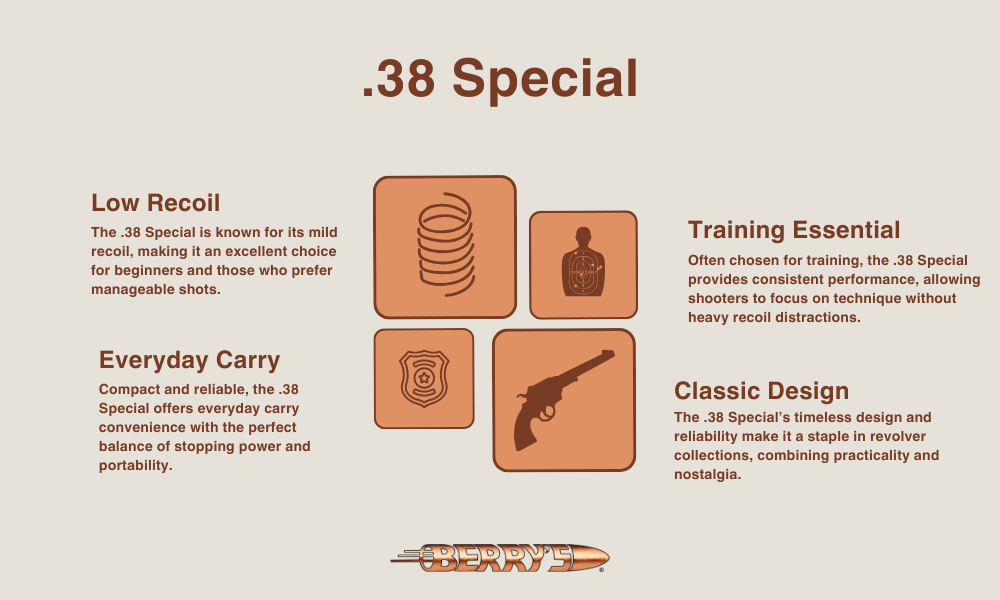
The .38 Special trades the magnum’s raw power for shootability. It is the cartridge most American shooters first learned on, the round most police carried for nearly a century, and the load most newer revolver shooters reach for today.
Specs and Performance
The .38 Special uses an identical .357 bullet diameter to the .357 Magnum but in a shorter special case of 1.155 inches. Overall length runs 1.550 inches, with a max pressure of 22,000 PSI, half what the magnum operates at. Standard pressure .38 special load velocities run 750 to 850 fps. The special brass operates at lower pressure and uses less case capacity than the magnum case, which is why recoil and report stay so much milder.
Ballistic Performance
Energy in standard pressure runs 185 to 333 ft-lbs, well below magnum territory but plenty for typical defensive distances. .38 Special +P ammo opens up performance further, and .38 +P load options give shooters a middle path between standard pressure and a full magnum cartridge. Recoil stays mild even in the lightest carry platforms.
Applications
The .38 Special covers different ground than the magnum, with carry and training at the center:
- Concealed Carry: A defensive option in compact revolvers like the snub nose revolver and other small-frame platforms made for pocket carry.
- Personal Protection: Lighter recoil makes follow-up shots faster in a small carry gun.
- Home Defense: Reduced velocity lowers over-penetration risk compared to full house magnum loads.
- Target Shooting: Affordable to shoot, soft on the hands, and accurate enough for serious range work.
- Versatile Platforms: Chambered in J frame, K frame, and L frame special revolver options, plus any .357 Magnum revolver.
Performance Comparison
Run the two cartridges side by side and the gap appears immediately. The .357 Magnum produces nearly twice the muzzle energy, much sharper muzzle blast, and roughly double the recoil. The .38 Special gives that performance back in exchange for a softer, cheaper, easier-shooting experience.
Velocity and Energy
.357 magnum loads sit at 1,200 to 1,500 fps with 539 to 783 ft-lbs of muzzle energy. Standard .38 Special ammo runs 750 to 850 fps with 185 to 333 ft-lbs. The magnum case carries more powder, runs at higher pressure, and produces higher velocity. The special case stays mild by design.
Recoil and Shootability
The .38 Special is famously easy to shoot. The .357 Magnum is famously not. Stepping up to full house magnum loads creates heavy recoil that punishes a poor grip and can rattle a newer shooter into bad habits. That dynamic is exactly why so many .357 owners practice with .38 Special and reserve hot magnum ammo for hunting or defense.
Effective Range
Both cartridges live at close to moderate range. The .357 stretches further with usable energy, especially out of a longer barrel, while the .38 stays inside short defensive distances and target ranges. Neither is a long-distance round.
Cost and Availability Considerations
Reloading components for both rounds are widely stocked and well documented in published load data. The .38 Special costs noticeably less to feed because it uses less powder per round and pairs with cheaper brass.
Component and Reloading Cost
Berry’s plated bullets for .38/.357 reloading sit at roughly $130-$160 per 1,000 or $35-$50 per 250-count box, with primers, powder, and brass priced separately. The same Berry’s bullet works in either cartridge, which gives reloaders flexibility most other caliber pairings cannot match.
Platform Costs and Compatibility
Entry-level .38 Special revolvers tend to be lighter and more affordable than .357 Magnum platforms. A .357 Magnum revolver also chambers .38 Special, which is exactly why so many shooters buy a magnum platform and run mostly .38 special ammo through it for practice while saving magnum loads for serious applications.
Making Your Decision
Think about what you will actually shoot most. If most of your trigger time will be at the range or in a carry gun, the .38 Special wins. If hunting, lever gun work, or full-power defensive shooting matters more, the .357 Magnum wins. Reloaders can hedge either way because both rounds use the same bullet.
Choose the .357 Magnum If You Want:
- Maximum stopping power with nearly double the muzzle energy
- Hunting capability on deer-sized game at close range
- Lever gun reach with notably higher velocity from a longer barrel
- Magnum-level performance for personal protection in a full size revolver
- A revolver that also fires .38 Special for affordable practice between magnum sessions
Choose the .38 Special If You Want:
- Soft-shooting recoil that supports faster follow-ups and longer range sessions
- Lower cost per round for high-volume target shooting and reloading
- Compact carry options in lightweight J frame and snub nose revolver platforms
- An ideal beginner cartridge to build fundamentals before stepping up to magnum loads
- +P ammo flexibility for stepped-up performance without moving up to a magnum revolver
Berry’s Bullets: Your Partner for .38/.357 Reloading
Berry’s makes plated bullets in both .38 Special and .357 Magnum profiles, built for handloaders who want jacketed-style performance without the jacketed-bullet price. Our copper plating fully encapsulates a lead core, which keeps range time cleaner and reduces lead exposure compared to traditional cast bullets. Each bullet is restruck after plating to hold tight tolerance on diameter and weight.
Because both cartridges share a bullet diameter, the same projectile loads either round. Profiles and weights in our .38/.357 lineup include:
- 125 gr Flat Point and 125 gr Target Hollow Point for lighter loads
- 148 gr Double-Ended Wad Cutter and 148 gr Hollow Base Wad Cutter for target shooting
- 158 gr Flat Point, 158 gr Round Nose, and 158 gr Target Hollow Point for full size 158-grain bullet loads
Defensive reloaders can step into our .38/.357 HHP self defense bullets, built around a hollow point profile aimed at personal protection use. Berry’s has supported the shooting community for four generations.
Frequently Asked Questions
Can a .357 Magnum revolver shoot .38 Special?
Any revolver chambered for .357 Magnum will safely fire .38 Special. The reverse is not true. The longer .357 round will not fit in a .38 Special revolver because of case length and pressure differences.
Are .38 Special and .357 Magnum bullets the same diameter?
Both rounds use a .357 bullet diameter. The magnum is not a larger bullet, only a longer case loaded to higher pressure. Reloaders can stock one bullet for either cartridge.
Which cartridge has more recoil?
The .357 Magnum, by roughly double. Muzzle blast is sharper too, especially out of a short-barreled revolver or lightweight carry gun.
Which is the better choice for new shooters?
The .38 Special. Softer recoil, lower component cost, and a wider range of compact platforms make it the easier starting point. Buying a .357 Magnum revolver leaves the door open to step up later.
Can the .357 Magnum be used for hunting?
Yes. Deer-sized game from a handgun at close range and out to roughly 150 yards from a lever gun, paired with heavier 158-grain bullet loads or full house magnum loads with appropriate energy for ethical kills.
SIGN UP FOR OUR NEWSLETTER