
Your cart is currently empty!
Blog
January 29, 2023

Blog
9mm vs .45 ACP: Which Handgun Caliber Is Right for You?
January 29, 2023
Short Answer: The 9mm fires a lighter bullet at higher velocity, holds more rounds, kicks less, and costs less to shoot. The .45 ACP fires a heavier, larger-diameter bullet that hits with slightly more energy but comes with more recoil and lower magazine capacity. Both are excellent self-defense rounds, and neither is ideal for hunting big game. The right pick depends on how you shoot, what you carry, and personal preference.
9mm vs .45 ACP: What’s the Difference?
The 9mm and the .45 ACP are two of the most popular pistol calibers in the world, and shooters have compared them for decades. On paper they are more alike than most people expect, but the differences that do exist shape how each round performs.
The 9mm (technically the 9x19mm Parabellum) is a smaller-diameter, higher-velocity round. The .45 ACP (Automatic Colt Pistol) is a wider, heavier, slower round. That single trade-off, speed and capacity against size and mass, drives almost every practical difference between them.
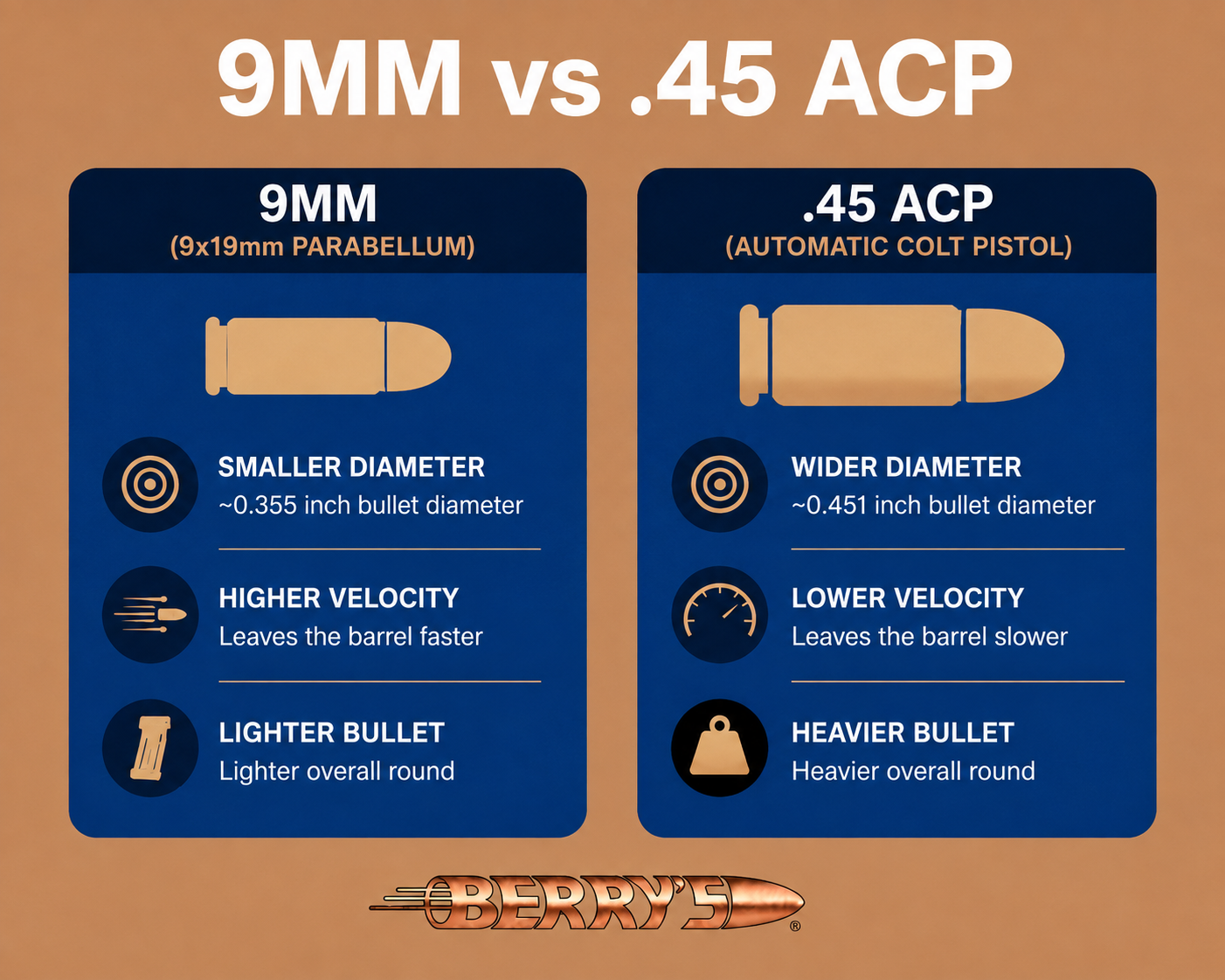
Quick Comparison: 9mm vs .45 ACP
| Spec | 9mm | .45 ACP |
|---|---|---|
| Bullet diameter | .355 in | .452 in |
| Common bullet weights | 100 to 147 gr | 185 to 230 gr |
| Typical muzzle velocity | 1,100 to 1,300 fps | 830 to 1,000 fps |
| Typical muzzle energy | ~340 to 400 ft-lbf | ~350 to 465 ft-lbf |
| Free recoil (full-size pistol) | ~4 to 6 ft-lbf | ~7 to 10 ft-lbf |
| Typical magazine capacity | 15 to 17+ | 7 to 13 |
| SAAMI max pressure | 35,000 psi | 21,000 psi |
| Relative cost per round | Lower | Roughly 50 to 60% higher |
The pressure and velocity figures above come from the published industry standards set by SAAMI. Real-world numbers vary with the specific load, bullet weight, and barrel length.
A Brief History of the 9mm
The 9mm traces back to the Luger pistol. Designed by the Austrian Georg Luger and first manufactured in 1900, the Luger was chambered in 7.65mm and 9mm and became the standard German service pistol from 1908 as the P08. Before that, Luger had demonstrated his new pistol and cartridge to the U.S. Army at Springfield Armory, one of several militaries that evaluated the design. The 9mm went on to see heavy use through both World Wars.
After both World Wars, law enforcement agencies around the world adopted the 9mm for its mild recoil, flat trajectory, and high magazine capacity. The United States military replaced the .45 ACP M1911 with the 9mm Beretta M9 in the 1980s, and in 2017 it selected the SIG Sauer M17 and M18, built on the P320, to replace the M9. Today the 9mm is the most widely used handgun cartridge in the world.
A Brief History of the .45 ACP
John Moses Browning designed the .45 ACP for a new Colt semi-automatic pistol, giving the U.S. Army the larger, harder-hitting round it wanted to replace its aging .38-caliber service revolvers. The Colt was adopted as the M1911 in 1911 and served as the standard U.S. military sidearm for more than 75 years, firing a 230-grain bullet.
The .45 ACP runs at lower chamber pressure than the 9mm, which produces a slower, push-like recoil rather than a sharp snap. It remains a favorite among 1911 shooters, competitive shooters, and anyone who prefers a bigger bullet. Both rounds also feed pistol-caliber carbines, which lets some shooters share one supply of ammo between a handgun and a long gun.
9mm vs .45 ACP: The Key Differences
Velocity and Trajectory
The 9mm is the faster round. Its lighter bullet and higher muzzle velocity give it a flatter trajectory and less drop at distance, which is a distinct advantage for longer shots. Its average velocity also pushes it past the speed of sound, so most 9mm loads are supersonic. Air resistance and gravity still slow both rounds downrange, but the 9mm’s smaller diameter helps it hold speed.
Most .45 ACP loads travel below the speed of sound, which is about 1,100 to 1,125 fps at sea level. Because they stay subsonic, they avoid the sharp crack a supersonic bullet makes when it breaks the sound barrier, which is one reason the .45 ACP suppresses so well.
Stopping Power and Energy
Muzzle energy (the kinetic energy a bullet carries as it leaves the barrel) is close between the two. The heavier .45 ACP holds a modest edge, roughly 350 to 465 ft-lbf against the 9mm’s 340 to 400 ft-lbf. The bigger bullet also cuts a wider hole and transfers energy across a larger area.
That said, modern ammunition has narrowed some of the performance differences between the two calibers. Bullet design, load selection, and the specific firearm can all affect real-world performance, so caliber alone does not tell the whole story.
Recoil and Follow-Up Shots
The 9mm produces roughly half the recoil of the .45 ACP. Lighter recoil is easier to control, which supports faster, more accurate follow-up shots and helps shooters with smaller hands or less grip strength. Recoil also affects shot placement, and good placement matters more than caliber in a defensive situation. The heavier, slower recoil of the .45 ACP is manageable for many shooters, especially in a heavier steel-framed 1911, but it takes more practice to master.
Magazine Capacity
The smaller 9mm round fits more cartridges in the same space. A double-stack 9mm pistol like the Glock 17 holds 17 rounds, while a comparable .45 ACP like the Glock 21 holds 13. Single-stack 1911s in .45 ACP typically carry 7 or 8. That higher magazine capacity means extra rounds before a reload, which many shooters count as a real advantage of the 9mm.
Cost and Availability
The 9mm is cheaper to shoot, usually costing 40 to 60 percent less per round than .45 ACP ammo. It is also stocked almost everywhere by ammo manufacturers. Lower cost translates directly into more practice for the same money, and practice is what builds skill with either caliber.
Which Should You Choose?
Self-Defense
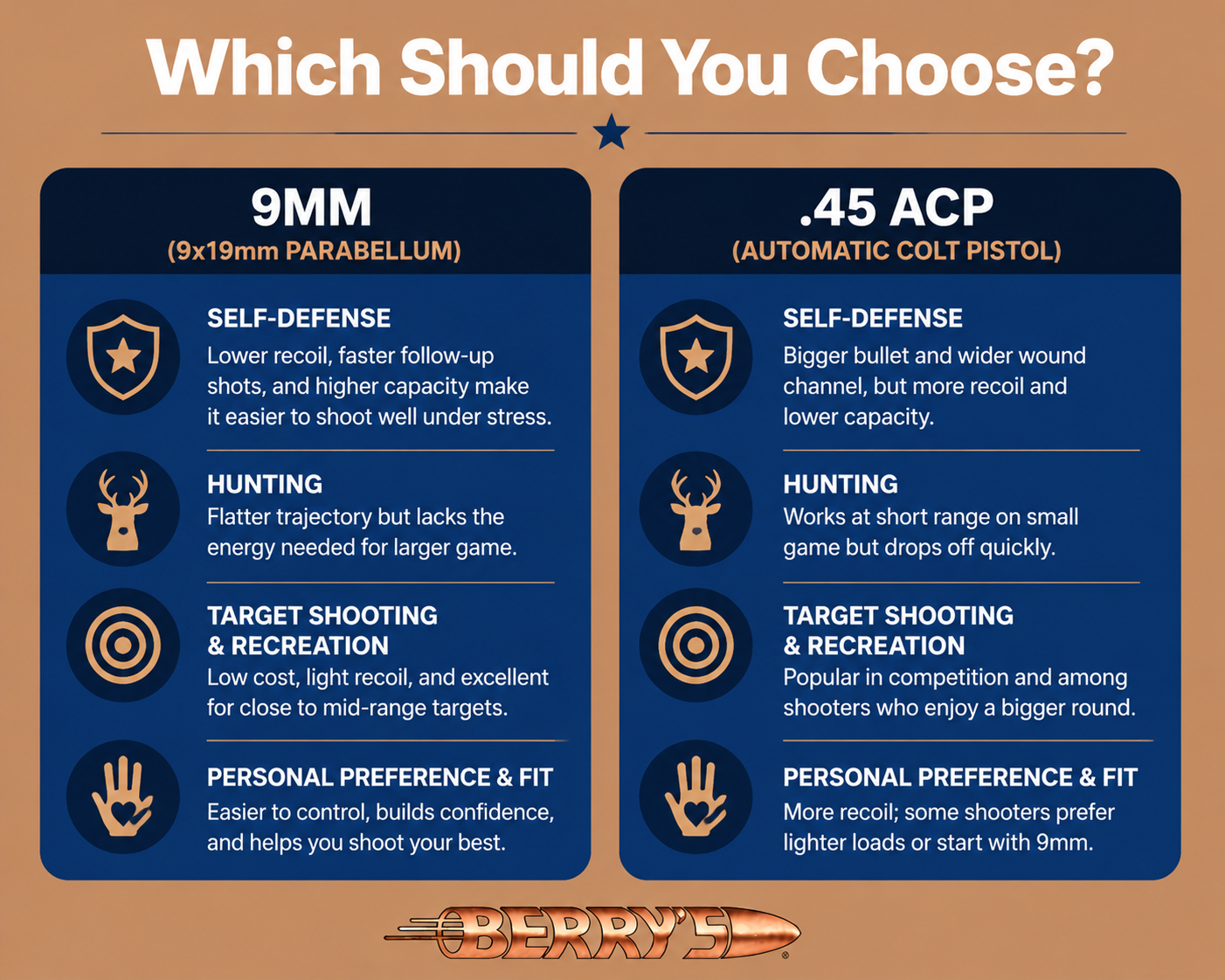
Both rounds work well for self-defense with quality hollow points. The .45 ACP delivers a bigger bullet and a wider wound channel, while the 9mm offers lower recoil, faster follow-up shots, and higher capacity. For most people, the 9mm’s balance of controllability and capacity makes it the easier round to shoot well under stress. For a deeper breakdown, see our guide to the best self-defense calibers.
Hunting
Neither round is a strong hunting choice. The .45 ACP works at short range on small game because it is big and hits hard, but it drops off quickly. The 9mm has a flatter trajectory but lacks the energy to reliably take larger game. For hunting, a dedicated rifle or magnum handgun cartridge is the better tool.
Target Shooting and Recreation
For range days and casual shooting, the 9mm’s low cost and light recoil are hard to beat, and it shines on close and mid-range targets. The .45 ACP has a devoted following in competition and among shooters who simply enjoy a bigger round. At typical target distances, both are accurate and satisfying to shoot.
Personal Preference and Fit
The bottom line is that how a pistol fits your hand often matters more than the caliber on the box. If a grip is a stretch for your hand or the recoil makes you flinch, your accuracy suffers. Shooters who find the .45 ACP snappy can start with a 9mm and work up, or reload the .45 lighter to soften it. Handle both, shoot both if you can, and let fit and confidence guide the choice.
Reload Both with Berry’s Bullets
Berry’s is a one-stop shop for reloading either caliber. Our 9mm bullets come in 16 options from 100 to 147 grains, and our .45 ACP bullets run from 185 to 230 grains across round nose, flat point, hollow point, semi-wadcutter, and round shoulder profiles. Because you control the load, you can even set up a .45 ACP with a lighter charge that shoots closer to a 9mm in feel.
For defensive loads, Berry’s Hybrid Hollow Points are available in both 9mm and .45, built to expand on impact while keeping range costs low. Round out your bench with Berry’s reloading accessories and ammo boxes to keep every load organized and labeled.
Whether you shoot 9mm, .45 ACP, or both, matching your bullet choice to your goals is the first step toward better rounds. Always follow your reloading manual and published load data, and check your local laws before you load.
SIGN UP FOR OUR NEWSLETTER