
Your cart is currently empty!
Blog
June 11, 2026
Blog
10 Reloading Bench Organization Ideas for a Smarter Setup
June 11, 2026
At a Glance: To organize a reloading bench, separate components from loaded ammo, label every load with caliber and powder details, store primers and powder in their original packaging, and zone your work surface by task (brass prep, priming, powder, seating). A well-organized reloading bench reduces mistakes, protects components from contamination, and keeps each loading session moving.
A messy reloading bench costs time and creates safety risk. Components get mixed up. Labels go missing. Powder ends up next to brass that has not been cleaned yet. The fixes are not complicated, but they do take some intention.
This guide covers 10 practical reloading bench organization ideas that any reloader can put to work, from a small garage corner to a dedicated reloading room. Every idea is grounded in real reloading workflow, not just gear for gear’s sake.
1. Sort Loaded Ammo by Caliber in Dedicated Ammo Boxes
Loaded ammo belongs in caliber-specific boxes the moment it comes off the press. Mixing loaded ammo with components on the bench top is the most common cause of confusion during a reloading session.
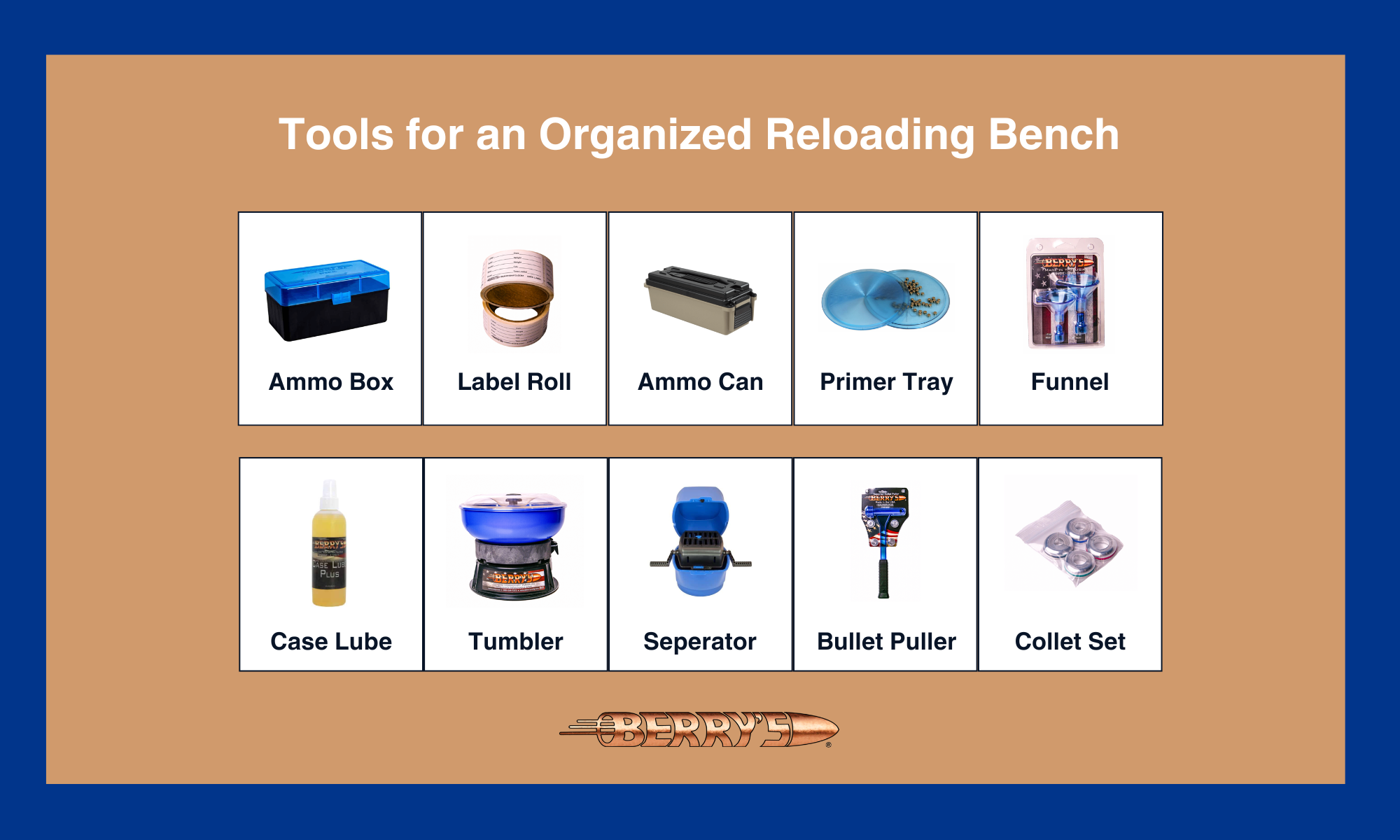
Berry’s Ammo Boxes come in:
- 10, 20, 50, and 100 round configurations for pistol and rifle
- Shotshell ammo boxes for shotgun reloads
- Utility boxes for odd-count batches and load development samples
Color-coded lids help separate different loads of the same caliber, like a 9mm range load versus a 9mm defensive load. A finished box should never sit on the loading area without going straight to a labeled storage shelf.
2. Use Data Labels to Track Every Load
Label every loaded ammo box the moment it comes off the press. Unlabeled boxes are useless six months later when you cannot remember the powder charge or bullet weight.
Berry’s Data Label Roll gives reloaders 100 pre-printed labels per roll for tracking the basics:
- Caliber
- Bullet weight and profile
- Powder type and charge
- Primer brand
- Date loaded
- Lot number for traceability
Good labeling matters most when a batch needs to be pulled down. Without labels, the only safe option is to disassemble every round one by one and start over.
3. Store Components in Stackable Ammo Cans
Primers, brass, and bullets all need protection from moisture, dust, and direct light. Stackable ammo cans solve all three problems and keep the bench top clear.
Berry’s offers a full range of options:
- MiniCan for small component batches and short brass
- Tri-Can with three stacking compartments for sorting by caliber
- 20, 30, and 40 cal ammo cans for bulk component storage
Stack them on a bottom shelf or in upper cabinets to keep components organized and out of the way of active loading.
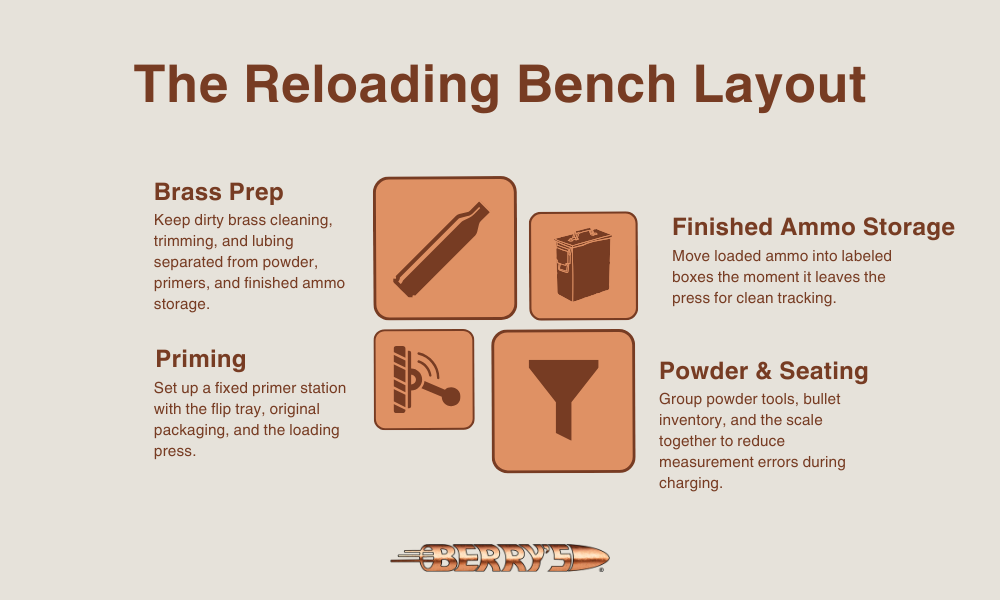
4. Set Up a Dedicated Primer Station
Primers need a fixed spot on the bench with no other components nearby. The biggest priming mistake is mixing brands or magnum and standard primers in the same tray.
A Berry’s Primer Flip Tray handles 100 primers at a time and aligns them anvil-up for fast pickup. Best practices for a primer station:
- Keep primers in their original packaging until use
- Never mix brands or types in the same tray
- Store unused primers away from heat sources
- Keep a separate flip tray for small pistol, large pistol, small rifle, and large rifle if you load multiple calibers
A dedicated primer station also speeds up priming on both a single stage press and a progressive setup.
5. Keep Powder Tools in One Place
Powder measuring tools belong together, separated from priming and seating tools. A grouped powder station reduces measurement errors and keeps powder away from primers.
The Berry’s powder lineup covers the basics:
- Powder Funnel Set for transferring powder into cases across different calibers
- Case Lube for smooth resizing before powder charging
- Powder storage should be in original containers, in a cool dry spot, away from primers
A powder measure mounted to the bench is the heavy duty option for high-volume loading. For a single stage workflow, a hand-held powder thrower paired with a scale works fine.
6. Designate a Brass Cleaning Zone Away From Components
Dirty brass should never share space with clean components or powder. Cleaning brass produces dust and media fragments that contaminate everything nearby.
Berry’s brass cleaning equipment includes:
- Vibratory tumblers for cleaning brass with corncob or walnut media
- Polish and media for refinishing brass between cleanings
- Media separators and kits for separating clean brass from spent media
Set the cleaning zone on a separate work table or in a different corner of the garage. A case trimmer also belongs in this zone since trimming creates brass shavings.
7. Organize Bullet Inventory by Caliber, Grain, and Profile
Bullet inventory is the easiest thing to lose track of on a reloading bench. A 9mm 115gr round nose looks nearly identical to a 9mm 124gr round nose at a glance, but the load data is different.
Sort bullets by:
- Caliber first (9mm, .45 ACP, .223, etc.)
- Grain weight second (115gr, 124gr, 147gr)
- Profile third (round nose, flat point, hollow point)
Berry’s Superior Plated Bullets ship in clearly labeled boxes that make caliber and grain easy to spot. Keep them in caliber-specific storage so the right bullet is always within reach during the seating stage.
8. Keep a Bullet Puller Within Arm’s Reach for Quick Fixes
Every reloading bench needs a bullet puller. Mistakes happen, and pulling a bad load is faster and safer than firing it to find out what went wrong.
Berry’s Superior Bullet Puller breaks down loaded ammo without damaging the bullet or case. Pair it with a Bullet Puller Collet Set for caliber-specific grip.
Common reasons a reloader pulls a bullet:
- Wrong powder charge identified before firing
- Bullet seated too deep or not deep enough
- Suspected double charge or no charge
- Batch needs to be reworked due to a labeling mix-up
Mount the puller on the right side of the bench if you are right-handed, left side if you are left-handed, so it is always within reach without breaking workflow.
9. Mount the Table Top Base for a Dual-Purpose Bench
A reloading bench does not have to be single-purpose. Mounting a vise platform on the same work bench turns it into a dual-purpose station for both reloading and occasional gun cleaning between loading sessions.
Berry’s Table Top Base Module bolts to a workbench, butcher block top, or even a solid core door rigged on heavy duty legs from the hardware store. Some reloaders add a metal plate under the press mount for extra rigidity. Mounted on the bench, the Table Top Base accepts the 360° Ball & Case for adding a vise, scope-mounting platform, or other modular tools without crowding the reloading area.
For reloaders who shoot what they load, having gun cleaning and reloading on the same bench is a major space-saver, especially in a small garage or shared work bench setup. Plenty of old school reloaders run this kind of combo setup, and it is the concurring opinion across most experienced reloading forums.
10. Build a Maintenance and Repair Drawer
The small tools that wander off the bench are the ones reloaders need most. Calipers, kinetic mallet, dial wrench, brush set, and notebook all belong in a dedicated drawer or shelf.
A typical maintenance drawer should hold:
- Calipers for measuring case length and OAL
- Small screwdrivers and Allen keys for press adjustment
- Brush set for cleaning dies and powder measure
- A reloading notebook for tracking load development
- Spare decapping pins and shellholder plates
Keeping these tools off the bench top keeps the work surface clear for actual loading. A small parts organizer in a drawer beats loose tools on counter tops every time.
Build a Better Reloading Bench with Berry’s
A well-organized bench is the foundation of consistent reloads. Whether you run a Rock Chucker single stage press or a progressive setup, the same organization principles apply: zone your workflow, label everything, store components separately from loaded ammo.
Berry’s Bullets has been manufacturing reloading equipment and components in the U.S. for over 60 years. Check out our complete range of products for all your reloading needs:
- Superior Plated Bullets
- Reloading Accessories
- Ammo Storage Solutions
- Brass Cleaning
- Shooting Bench & Rest
For shooters who do their own gunsmithing alongside reloading, Berry’s Modular Gunsmithing Tools expand the same bench into a dedicated gunsmithing workstation with a gun vise, machine vise, checkering cradle, and other modular attachments.
SIGN UP FOR OUR NEWSLETTER