
Your cart is currently empty!
Blog
October 07, 2026
Blog
What Is MOA in Shooting?
October 07, 2026
Short Answer: MOA stands for minute of angle, an angular measurement equal to 1/60th of one degree. In shooting, one MOA spreads to about one inch at 100 yards, two inches at 200 yards, and so on as the distance grows. Shooters use MOA to adjust a scope, measure group size, and correct for bullet drop at longer distances. Because it is an angle and not a fixed length, one MOA covers a bigger area the farther out you go.
What Is MOA in Shooting?
MOA is short for minute of angle, sometimes called minute of arc. It is a unit of angular measurement, not a linear measurement like an inch or a yard. A full circle holds 360 degrees, and each degree divides into 60 minutes, so one MOA is 1/60th of a single degree.
That sounds abstract until you point it downrange. According to the National Shooting Sports Foundation, one MOA spreads about one inch per 100 yards, or more precisely 1.047 inches. Because it is an angle, the size it covers grows with distance in a straight line:
- 1 MOA at 100 yards is about 1 inch
- 1 MOA at 200 yards is about 2 inches
- 1 MOA at 300 yards is about 3 inches
- 1 MOA at 500 yards is about 5 inches
- 1 MOA at 1,000 yards is about 10 inches
The same one-minute angle is a one-inch circle up close and a ten-inch circle far away. That scaling is the whole reason MOA is useful. It gives you one consistent way to talk about precision and adjustment at any target distance.
True MOA vs Shooter’s MOA
Here is a detail most shooters round past. One MOA is not exactly one inch at 100 yards. The true figure is 1.047 inches. The “one inch” version is a convenient approximation that the shooting world adopted because the math is easier.
The difference is small enough to ignore at normal ranges. At 100 yards it is less than five hundredths of an inch. But it compounds with distance. At 1,000 yards, true MOA works out to about 10.47 inches while the rounded version gives you 10 inches, a gap of nearly half an inch. Stack several MOA of adjustment on top of that and the error grows.
Because of this, some optics are marked in SMOA, or shooter’s MOA, which is rounded to exactly one inch at 100 yards. For most hunting and target work inside a few hundred yards, the rounded inch is fine. For a long-range shooter reaching way out, the 1.047 figure is worth using in the math.
Why Shooters Use an Angle Instead of Inches
A bullet does not travel in a straight line. It leaves the barrel and immediately begins to arc downward as gravity pulls it toward the ground, and it slows the whole way as air resistance works against it. The farther the target, the more the bullet drops below your point of aim. If you want the full picture of what happens to a bullet after it leaves the muzzle, see our guide to how fast a bullet travels.
If you measured corrections in inches alone, every distance would need its own separate rule. MOA solves that. Since one MOA is always the same angle, you can think in MOA at any range and convert to inches only when you need to. Dial one MOA of elevation and your point of impact moves one inch at 100 yards, three inches at 300 yards, or five inches at 500 yards, all from a single adjustment on the scope.
How to Use MOA to Adjust Your Scope
Most MOA scopes adjust in 1/4 MOA increments, meaning each click of the turret moves your point of impact 1/4 inch at 100 yards. Some target optics use 1/8 MOA clicks for finer control.
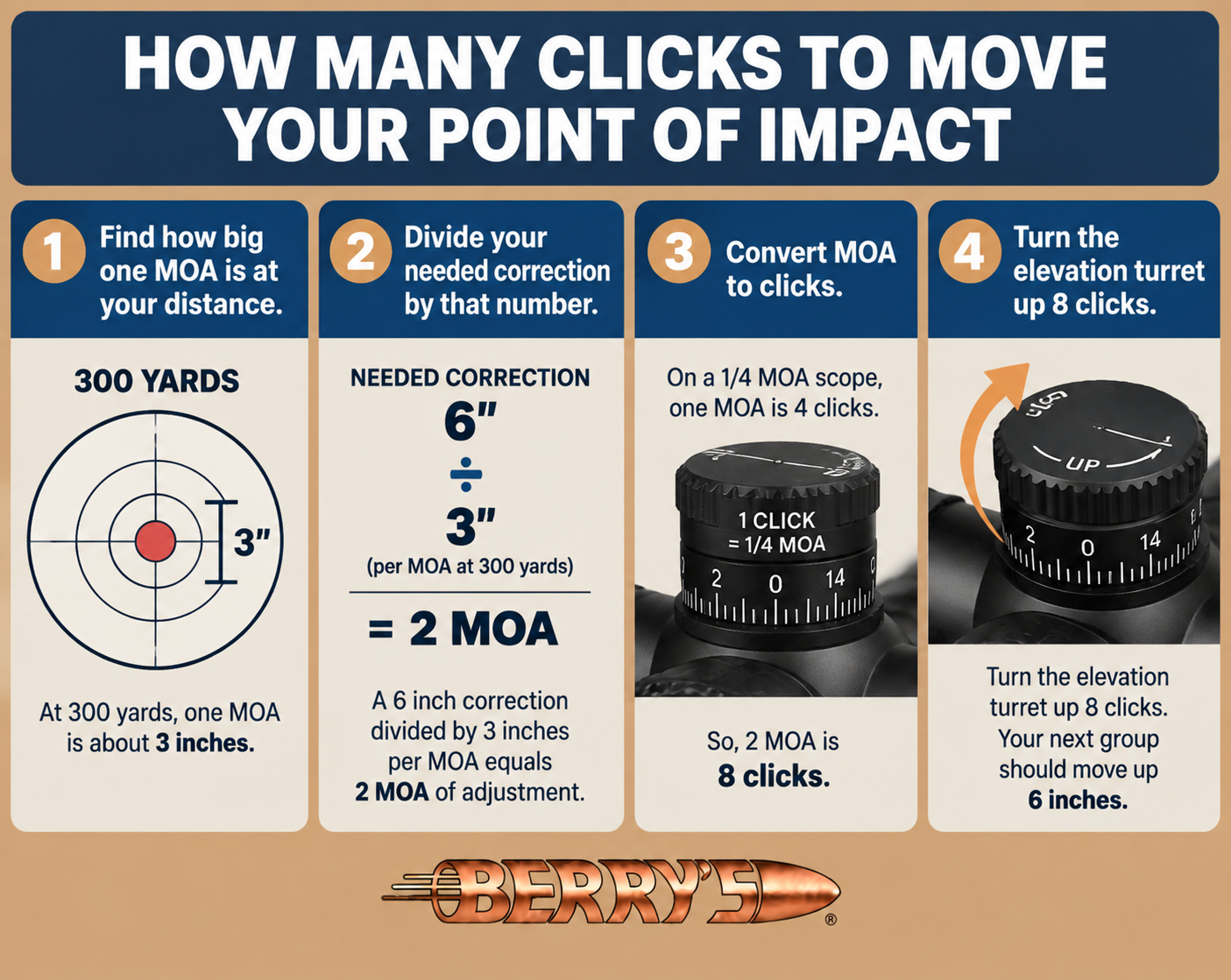
The process for a scope adjustment works like this. Say you are shooting at a 300 yard target and your shots land 6 inches low.
- Find how big one MOA is at your target distance. At 300 yards, one MOA is about 3 inches.
- Divide your needed correction by that number. A 6 inch correction divided by 3 inches per MOA equals 2 MOA of adjustment.
- Convert MOA to clicks. On a 1/4 MOA scope, one MOA is 4 clicks, so 2 MOA is 8 clicks.
- Turn the elevation turret up 8 clicks. Your next group should move up 6 inches.
Windage adjustment works the same way on the horizontal turret. The key is to do the MOA math first and bring clicks in only at the end, which keeps the numbers clean.
Using MOA to Measure Group Size
MOA also describes how accurate a rifle is. When someone calls a rifle a “one MOA gun” or says it shoots “sub-MOA,” they mean it can put a group inside one inch at 100 yards, or under one MOA at whatever distance they tested.
To measure your own group size in MOA, use this formula:
MOA equals group size in inches, divided by distance in yards, times 100.
Measure your group center to center between the two widest holes, not edge to edge. If a three-shot group at 100 yards spreads to 2 inches, that is a 2 MOA group. The same 2-inch spread at 200 yards would be a 1 MOA group, since the shots held the same angle over twice the distance.
MOA Scopes, Rails, and Mounts
MOA shows up in your hardware too, not just your math. A scope reticle marked in MOA gives you reference points for holdover and ranging without touching the turrets. A matching MOA scope and MOA reticle let you measure a miss and correct it in the same unit.
For long range shooting, the adjustment range inside the scope can run out before you reach your target distance, because the bullet drops so far that you need more elevation than the turret holds. A MOA rail, also called a MOA base or MOA mount, solves this. It tilts the scope slightly downward, which shifts the entire adjustment range toward more elevation. A 20 MOA rail is a common choice for long range setups, while a zero MOA rail keeps everything flat for standard distances. The right scope base and mount combination depends on your rifle, your scope height, and how far you plan to shoot.
Why MOA Matters for Your Shooting
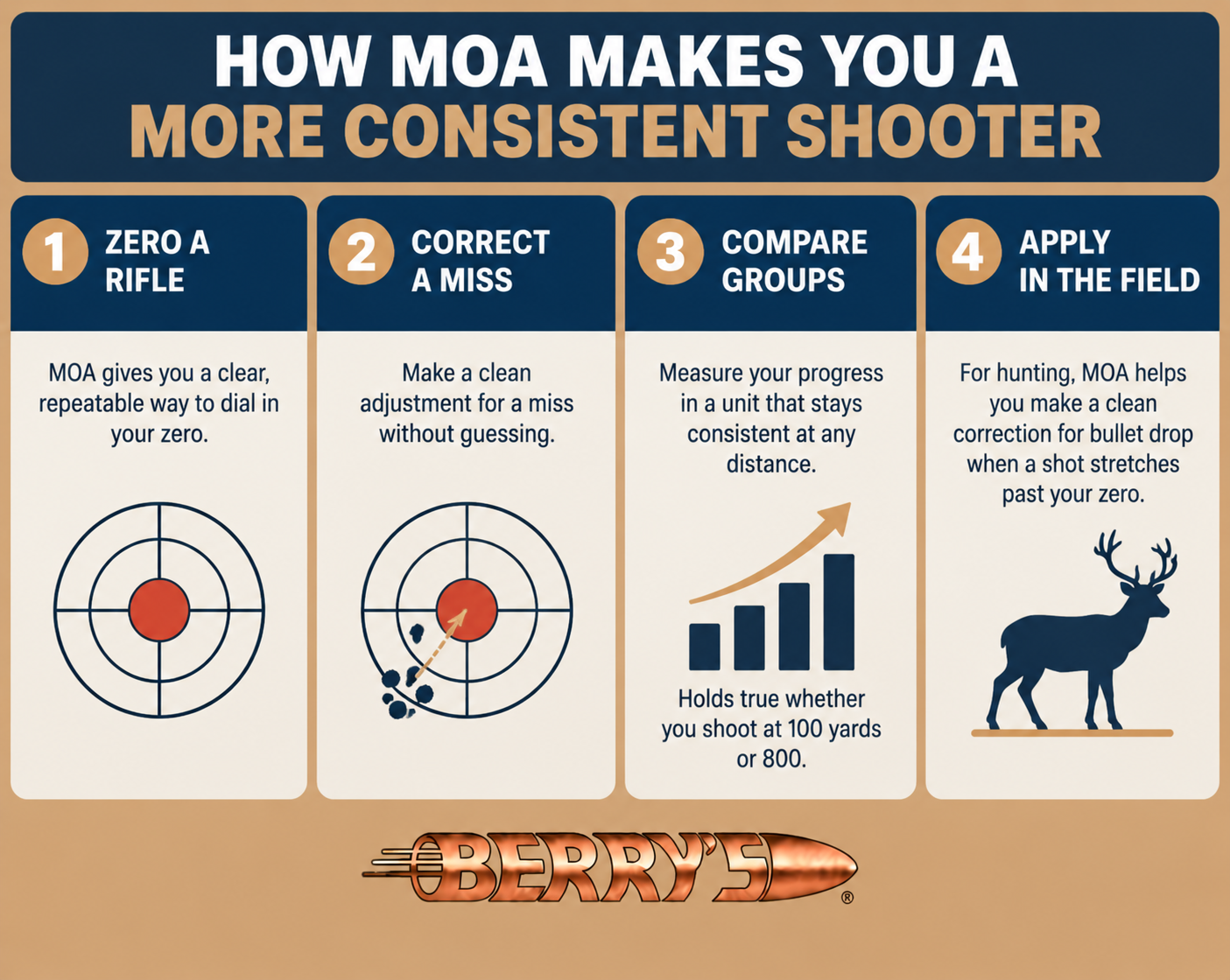
MOA turns a scattered set of guesses into a repeatable system. Once you think in minutes of angle, you can zero a rifle, correct a miss, compare groups across distances, and read a ballistic calculator output, all in one consistent unit.
For hunting, that means a clean correction for bullet drop when a shot stretches past your zero. For target and precision work, it means measuring progress in a number that holds true whether you shoot at 100 yards or 800. The more consistent your ammunition is shot to shot, the more that MOA math actually holds up on paper.
Build Consistent Ammo with Berry’s Bullets
Precise scope adjustments only pay off if your ammunition performs the same way every shot. Inconsistent rounds scatter your group no matter how well you dial your turrets, which makes it impossible to tell a load problem from a scope problem.
If you reload, you control that consistency. Berry’s Superior Plated Bullets are made to tight tolerances for uniform weight and shape from round to round, which helps keep your velocity and your groups predictable at any target distance. They come in popular handgun and rifle calibers across a range of grain weights and profiles, so you can match your bullet to your load data and your intended use.
Berry’s also carries the reloading accessories, brass cleaning supplies, and ammo boxes that support the rest of your bench. Build rounds you can rely on, then let your MOA adjustments do their job.
Always follow your reloading manual and published load data, and check your local laws before you load.
SIGN UP FOR OUR NEWSLETTER