
Your cart is currently empty!
Blog
January 12, 2026
Blog
10mm vs 357: Which is Better for Me?
January 12, 2026
Table of Contents:
- Cartridge Specs
- Velocity/Penetration
- Recoil
- Magazine Capacity
- Uses
- Why Choose Berry’s for Your Bullets
Which is better, the 10mm or the .357 round? This is a question we hear a lot. The answer might surprise you. Neither is better. They are each just slightly different. Those differences give one strength over the other as the circumstances change and the stronger one is not always the same round.
The 10mm will be superior in some scenarios, and the .357 will win out over the 10mm in other scenarios. The real question is, what do you want the round to do? When you ask that question, you can better choose between the two.
Factors That We Look At
Barrel length is a factor that can impact bullet performance. Average velocity, ballistic gelatin results, and how you use the round (target practice, hunting, or self-defense) also play a part in how ammo performs. There are a lot of variables when you compare ammo: caliber, longer ranges, longer barrels, heavier bullets or rounds, mm vs magnum, revolver cartridge vs rifle cartridge, and more.
1. Cartridge Specs
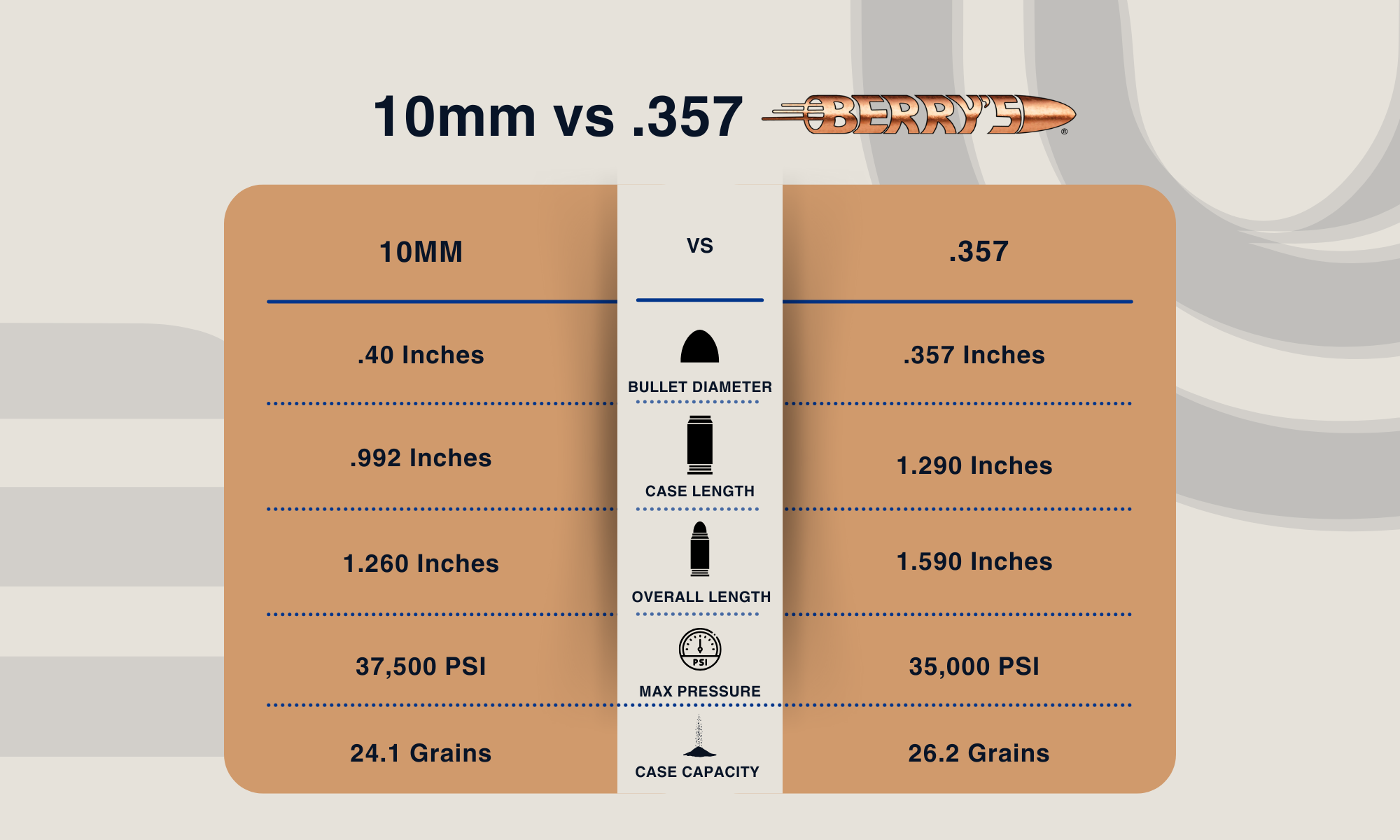
Bullet Diameter
- 10mm is equal to .40 inches
- 357 Magnum is equal to .357 inches
In terms of diameter, the .357 Magnum is slightly narrower than the 10mm. That may have a difference in power and velocity depending on the length of the casing and the size of the grains. Higher pressure loads or hot loads can be telling, as will be the stopping power, but you need more information to make that determination. There is little difference between a hunting scenario vs. a self-defense situation.
Case Length
- 10mm is .992 inches long
- .357 case length is 1.290 inches
The .357 offers a longer case length, which helps to offset its slightly narrower diameter. That means that you could find more powerful combinations in the .357 loads over the 10mm loads. However, either option presents a powerful cartridge with plenty of muzzle energy.
Overall Length
- 10mm has an overall length of 1.260 inches
- .357 Magnum has an overall length of 1.590 inches
The .357 Magnum round is longer than the 10mm round. Part of that has to do with the fact that the 10mm round is rimless, while the .357 Magnum is designed with a rim that helps it sit in the chamber properly.
That difference also comes down to gun design. Guns designed to handle the rimless 10mm round are generally semi-automatic pistols. 10mm auto pistols are very popular with law enforcement and those who want to deliver round after round in a short period. In self-defense, you may only have one shot or an exceedingly small window to take down a target. The 10mm auto pistols can do that.
Max Pressure in PSI
- 10mm offers a max pressure of 37,500 PSI
- .357 Magnum has a max pressure of 35,000 PSI
The 10mm round has more pressure than that of the S&W .357 round. However, when you look at muzzle velocity, you find that there is a lot of back and forth between the two rounds. Much of the fight between them comes down to how the rounds are configured, including grain load and bullet weight. Which of these two rounds is better? It comes down to the configuration of the round and how you plan to use it. More is sometimes less, and a smaller or slower round might outperform a bigger and more powerful round given the right set of circumstances.
Case Capacity in Grains
- 10mm has a case capacity of 24.1 grains
- S&W .357 has a case capacity in grains of 26.2
Part of the difference here is the longer casing of the .357, even though the 10mm is a slightly fatter round. The higher capacity here goes to the magnum revolver with the .357 round. More grains can mean heavier bullet weight and a shorter trajectory.
Another important aspect here for self-loaders over factory ammo is that with the longer casing and more grains from the .357, you might find you can self-load a special mixture with unique properties.
The .357 caliber bullet was an upgrade to law enforcement agencies over the .38 special rounds. But many may be reaching for the .40 handgun cartridge due to the speed of the semiautomatic.
Base Diameter
- 10mm has a base diameter of 0.425 inches
- The .357 Magnum cartridge has a base diameter of 0.379 inches
2. Velocity/Penetration
Is there a hands-down winner when it comes to velocity and penetration between these two rounds? A lot goes into that argument, especially shot placement at various distances. A conversion barrel over a stock barrel will also have a role to play in the outcome here, and even a shorter barrel can affect performance significantly.
If you are hunting, you might realize the difference in accuracy and velocity vs penetration simply by analyzing the differences in your target. Think black bear vs. brown bear vs. polar bear. Same beast but a different build. Your Smith & Wesson .357 magnum rounds might achieve higher velocity simply because they can fire bullets that are lighter than those of the Glock 10mm.
In FBI ballistic gel testing, the .357 was an overachiever. It overpenetrated in comparison to the 10mm handgun cartridge. That can be a problem in a self-defense situation. You don’t want the rounds to exit the target and deploy through walls where they may harm victims. The type of round you choose can reduce excess penetration. Hard cast bullets, for example, behave differently from hollow points.
The smaller case capacity offered by the semi-auto 10mm round means it generally has a slower muzzle velocity. Compare that to the slightly larger casing diameter means that bullets from the semi-auto can be heavier.
Regardless, both rounds were designed for law enforcement, and the differences that we explore here are small.
3. Recoil
Recoil is a big consideration for all shooters. A smaller body handling a gun with massive recoil is going to shy away from pulling the trigger a second time. They will anticipate the recoil, which can slow down shooting and remove focus from targeting to worrying over recoil.
Whether you are talking about home protection or bear protection, recoil becomes an issue. There is no way to get around the heavy recoil of both the .357 and the 10mm. They are both designed to make a big hole.
A few factors can help reduce felt recoil:
- Bullet grain size rating
- Slower muzzle velocity
- Lighter bullet weight (not the round itself)
- Using a longer inch barrel for better balance
In general terms, the .357 magnum ammo will most likely have a harsher recoil. That is due to the slightly higher velocity of the rounds. A Colt Delta Elite, which is a semi-automatic pistol, would be a slightly better option for a new shooter or a small shooter who needs less recoil. The .357 is likely going to transfer more power into the wrist, and that makes a second shot harder to retarget and then refire.
4. Magazine Capacity
There is no doubt about which of the two wins in magazine capacity. The semi-automatic pistol can carry 10-15 rounds in its mag, depending on the type of magazine. A .357 revolver can carry anywhere from 5-6 revolver rounds. High-capacity options give you more chances to take down your target or engage multiple targets.
5. Uses
Hunting
Bear defense at home or camp is the primary hunting option for the .357 or the 10mm handguns. However, there are .357 rifles where effective barrel length plays a bigger role in performance. Both slugs will take down a deer, but you are going to have to be a perfect shot to do so ethically.
When it comes to bears, the 10mm is iffy. Bears have big bones, and you will need rounds that penetrate deeply and bypass bones. Otherwise, you just wound the animal and that makes a bear more deadly. Similarly, with the .357 magnum, your bear defense shot is going to need to be spot on to be a killing shot. Some shooters opt for extra power loads in these situations.
Target Shooting
Both the .357 and the 10mm are popular for target shooting. Target shooting is a good way to see which of the two you like better from a shooting perspective.
Self-Defense
Because accuracy for either of these calibers is going to come down more to user ability than the differences between the rounds, it is important to choose the caliber based on your ability to handle it. The rounds are that close in performance. Recoil and accuracy matter, but so does the ability to launch a second round quickly, especially if recoil is something that you fear. Ultimately, the better choice depends on your comfort level and shooting experience.
Why Choose Berry’s for Your Bullets
At Berry’s, you can buy both the 10mm and the .357 rounds in multiple configurations to match your shooting needs. For .38/.357 reloaders, we offer grain weights from 125gr to 158gr in a variety of bullet types. For .40 S&W/10mm shooters, we carry grain weights from 155gr to 220gr with a similar variety in bullet styles.
Our manufacturing process starts with precision-swaged lead cores that are then electroplated with copper to reach the exact weight. This method creates bullets with exceptional consistency and concentricity, directly improving your shot placement.
With over 80 bullet types in our lineup, Berry’s Bullets has earned recognition for manufacturing the finest copper plated bullets available. Our commitment to quality helps reloaders create handloaded ammunition that performs consistently, shot after shot.
Ready to stock up? Explore our .38/.357 bullets or browse our .40 S&W/10mm selection and discover why shooters across generations choose Berry’s for superior components.
SIGN UP FOR OUR NEWSLETTER