
Your cart is currently empty!
Blog
January 12, 2026
Blog
380 vs 9mm: Caliber Comparison
January 12, 2026
Table of Contents:
- .380 vs. 9mm: Overview
- Detailed Overview of .380 Caliber Bullets
- Detailed Overview of 9mm Bullets
- Choosing Between .380 and 9mm
- Why Choose Berry’s for Your Bullets
When it comes to selecting the right firearm, many factors come into consideration. One of the primary considerations is the caliber of bullet your firearm will be chambered in. Understanding the differences, advantages, and disadvantages between similar rounds will be a deciding factor in which firearm you choose. Today, we are going to evaluate two of the most popular rounds among gun owners, the .380 ACP and the 9mm.
Whether you’re a seasoned marksman looking for precision bullets for your recreational shooting or a new shooter eager to find the ideal caliber for target practice, we’re here to guide you to the best choice.
.380 vs. 9mm: Overview
When it comes down to deciding between firearms, bullet caliber plays a big role. It’s not simply about the size but the ballistic performance of the bullet. This includes aspects such as muzzle velocity, recoil, and effective range, to name a few.
Brief Historical Background: .380 vs 9mm
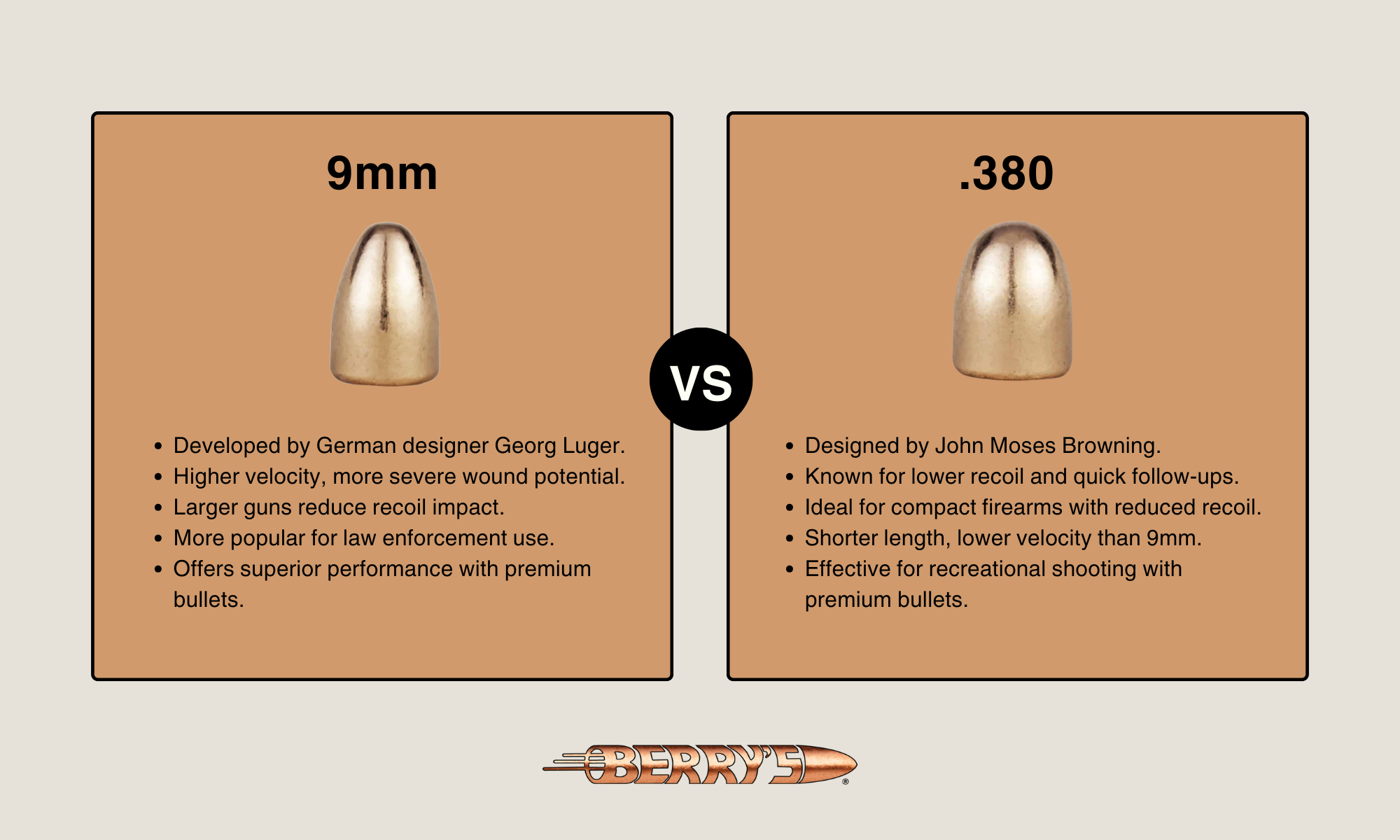
The .380 ACP is a rimless, straight-walled pistol cartridge designed by the great firearms designer John Moses Browning. Similarly, the 9mm Parabellum was developed by German firearms designer Georg Luger and introduced in 1901 for the Luger semi-automatic pistol. Each of these calibers has unique characteristics rooted in its design and performance, which we will discuss in more detail in the following sections.
Major Differences: .380 vs 9mm
At first glance, it might not be easy to spot the differences between the two. In terms of recoil energy, the shorter .380 ACP is known for having lower recoil, making it easier to manage and therefore quicker for follow-up shots. On the other hand, the 9mm, wielded by many law enforcement officers in the United States, compensates for its more substantial recoil with a higher velocity and longer-nosed bullet, which can lead to more severe wounds.
Keep in mind, the size of the gun is going to have the greatest effect on recoil. A larger gun chambered in 9mm is likely to have reduced recoil than a smaller gun chambered in .380 ACP due to decreased backward velocity. There are lots of factors that contribute to the overall shooting experience, which is why we recommend testing any firearm on the range before making a purchase decision.
Effectiveness for Recreational Shooting
The heart of the matter lies in the quality of recreational bullets. By choosing premium bullets, such as those we produce, you’re setting yourself up for optimal accuracy, consistency, and performance during target practice or competitive shooting. The right bullet choice leads to superior shot placement, helping you hit your mark each time.
As we delve deeper into the unique characteristics of the .380 ACP and 9mm, it’s important to look beyond just the calibers. Features like your firearm’s compact size, functionalities, magazine capacity, ease of use, and overall reliability also play a pivotal role in the firearm you select for your recreational needs.
Detailed Overview of .380 Caliber Bullets
Diving deeper into our caliber comparison of .380 versus 9mm, let’s start by taking a look at the .380 ACP. This caliber, also known as the 9mm Browning, 9mm Short, 9mm Kurtz, or simply .380, delivers a smaller diameter bullet at a lower velocity than many of its counterparts. Yet, it maintains considerable popularity, particularly among users who seek a weapon that is ideal for concealed carry.
Usage of .380 Caliber Bullets
The .380 ACP ammo is famously used in firearms such as the automatic Colt pistol (ACP), with designs embraced by the Ruger LCP and the Walther PPK, among others. The .380 ACP fires a generally lighter recoil round, making it easier to control. This is a factor to consider when time is of the essence in self-defense situations. In turn, the prospect of faster, controlled follow-up shots increases immensely, making the .380 an effective player in the world of firearms.
Beyond the civilian demographic, the .380 ACP has been used as a backup gun by several law enforcement outfits. The core reason for this choice is its smaller size, allowing the .380 caliber firearms to be conveniently carried, discreetly concealed, and quickly deployed if needed, all while providing reliable defense power.
Are .380 Caliber Bullets the Right Choice for You?
Commonly referred to as a pocket pistol due to their easily concealed size, the firearms chambered in .380 ACP are perfect for when traditional carrying options are not appropriate or possible. They slot into a pocket, purse, or even an ankle holster, with your firearm never far from reach in case it is needed.
However, it could be argued that the .380 ACP caliber lags behind others in terms of size and, consequently, the stopping power it offers. But with current advancements in recreational bullets, this argument is increasingly obsolete. The energy conveyed by a .380 round has dramatically improved, which, when combined with good shot placement, results in significant stopping power. The .380 ACP is a strong contender for those seeking manageable recoil, ease in concealed carry, and an effective defensive round.
Detailed Overview of 9mm Bullets
Moving on to the 9mm, officially entitled the 9mm Parabellum, more commonly known as the 9mm Luger, it occupies a higher standing among both firearm enthusiasts and law enforcement agencies. This caliber is renowned for delivering a higher velocity, given it is a longer and heavier bullet than the .380 ACP.
Strengths of 9mm Bullets
Unlike the .380 ACP, the 9mm has notably more recoil energy. Remember, this disadvantage can be offset by a larger firearm, and it means that the 9mm delivers a bigger punch. This is a factor that might be considered important to some shooters. Due to their popularity, firearms chambered in 9mm also tend to come with larger magazine capacities than those chambered in .380 ACP. This means the 9mm allows for more follow-up shots without needing to reload.
The blend of efficient muzzle velocity and larger caliber has led 9mm firearms to be a popular choice among law enforcement officers and individuals for personal defense across the United States. Among the variety of firearms leveraging this caliber are iconic models such as S&W’s M&P series and SIG Sauer’s P series.
For recreational shooting, range accuracy and consistency are significant elements, and the 9mm stands out in this aspect. The 9mm’s larger bullet and greater velocity grant it better accuracy at range over the .380 ACP. Paired with superior plated bullets, it guarantees improved shot placement and provides a satisfying shooting experience.
Are 9mm Bullets the Right Choice for You?
Considering the question of whether to choose the 9mm ultimately tracks back to personal comfort, adaptability, and the factor of what
feels right in your hands. While the 9mm typically has more recoil than the .380 ACP, many shooters can handle it effectively, making it an incredibly viable option for any shooter. A 9mm with a 4 inch barrel will also feel different than one with a short barrel, so test different configurations.
Choosing Between .380 and 9mm
As we come down to the wire in our comparison of the .380 ACP and 9mm, we clearly see that each caliber holds its unique profile based on size, velocity, recoil, and the potential firearms they operate within. So, how do you choose between the two?
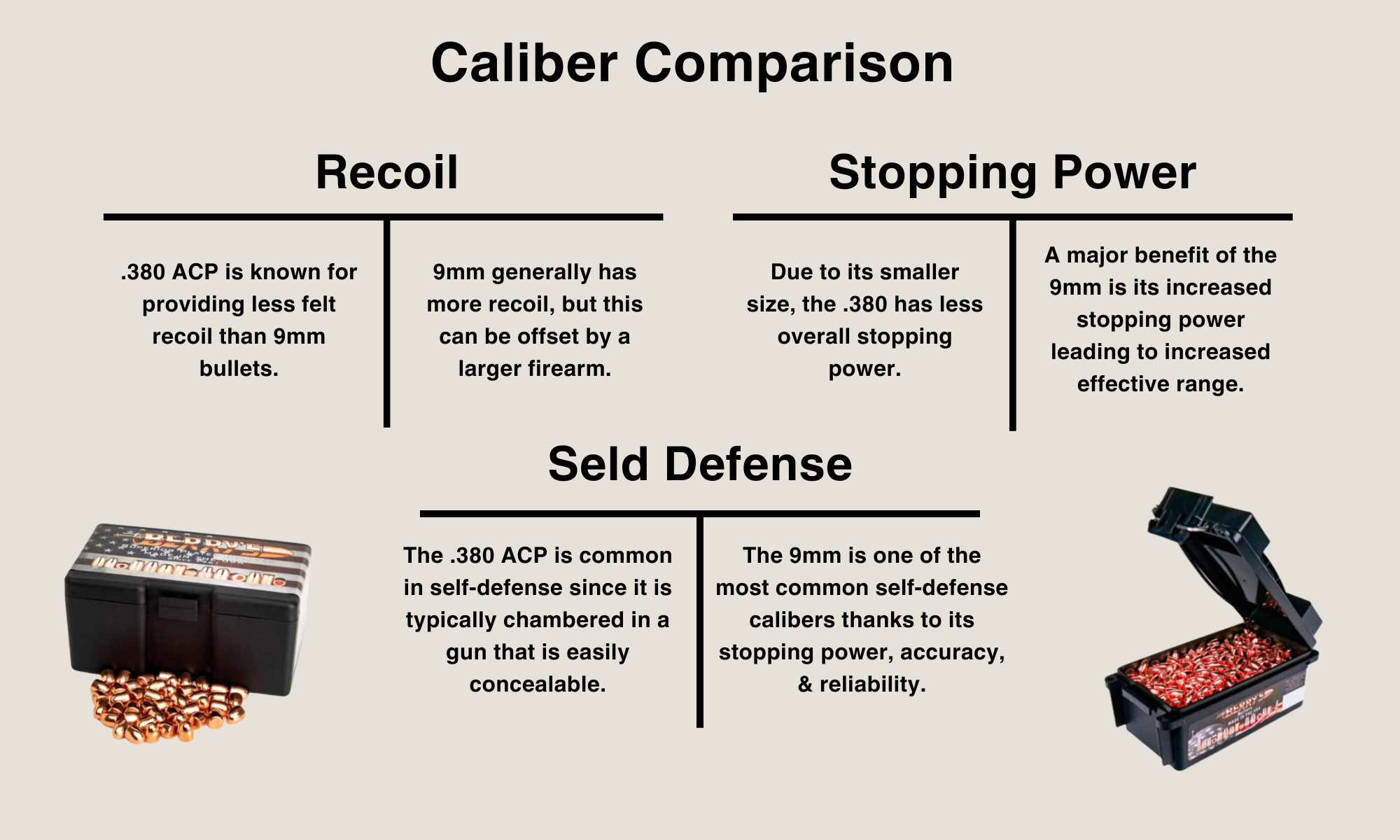
.380 vs 9mm: Key Differentiators
The .380 ACP offers the advantage of generally lighter recoil, making it a comfortable selection for those with a smaller build or who prefer a weapon that’s easier to handle. It serves as an optimal concealed carry, providing a practical round for self-defense. Its penetration depth, while not as substantial as the 9mm, has seen major improvements, especially when armed with high-quality bullets. Shooters can also choose from various bullet weights to match their needs, from a lighter grain bullet for less kick to heavier options.
The 9mm, on the other hand, offers increased stopping power due to its larger bullet diameter and higher velocity. It is a more powerful round overall. The more substantial recoil may be a setback for a few, but for many, the 9mm represents a trusted and reliable option. Moreover, the broad support of the 9mm in the law enforcement community attests to its dependability and effectiveness.
The Verdict: It Comes Down to Personal Preference
While we have dissected the attributes of two distinct calibers, your choice ultimately hangs on personal preference and comfort. Barrel length is another consideration, as it affects velocity and accuracy. Remember to consider the size and functionality of the firearm itself, as well as attributes such as magazine capacity, ease of carry, reliability, and the ability to handle the gun under stress.
Why Choose Berry’s for Your Bullets
At Berry’s, you can buy both .380 ACP and 9mm bullets in multiple configurations to match your shooting needs. For .380 reloaders, we offer 100gr bullets in styles like Round Nose and Hybrid Hollow Point. For 9mm shooters, we carry grain weights from 100gr to 147gr across many different bullet types, including Round Nose, Flat Point, Hollow Base, and Target Hollow Point options.
Our manufacturing process starts with precision-swaged lead cores that are then electroplated with copper to reach the exact weight. This method creates bullets with exceptional consistency and concentricity, directly improving your shot placement.
With over 80 bullet types in our lineup, Berry’s Bullets has earned recognition for manufacturing the finest copper-plated bullets available. Our commitment to quality helps reloaders create handloaded ammunition that performs consistently, shot after shot.
Ready to stock up? Explore our .380 caliber bullets or browse our 9mm selection and discover why shooters across generations choose Berry’s for superior components.
SIGN UP FOR OUR NEWSLETTER