
Your cart is currently empty!
Blog
February 09, 2026
Blog
Best .380 Bullet for Self Defense: What Actually Matters (and How to Pick Yours)
February 09, 2026
Table of Contents:
- What to Look for in a Self-Defense Bullet
- Why .380 ACP Bullet Choice Matters More Than People Think
- The 5 Criteria That Define a “Best” .380 Bullet
- Bullet Designs in .380 and What They’re Best For
- Berry’s .380 Bullets
At a Glance: The best .380 bullet for self defense is the one that feeds 100% in your pistol, reaches adequate penetration, and (when possible) expands without sacrificing reliability. In .380 ACP ammo, especially from handguns, bullet design and consistency matter as much as raw velocity. Test your setup before you carry it.
What to Look for in a Self-Defense Bullet
Picking the right defensive ammo starts with understanding your priorities.
- Reliability comes first. Your carry ammo must cycle flawlessly in your specific firearm.
- Penetration is non-negotiable. Law enforcement agencies use 12 to 18 inches in ballistic gel as the standard. A bullet that stops short of vital organs offers little real-world stopping power.
- Expansion is a bonus. A hollow point bullet that opens up creates a larger wound channel, but not if it causes under-penetration or feeding failures.
- Consistency matters. One impressive test means nothing if results vary shot to shot.
Why .380 ACP Bullet Choice Matters More Than People Think
The .380 ACP cartridge operates in tighter margins than larger calibers.
Compact pistols like the Ruger LCP Max feature shorter barrels. Barrel length directly affects velocity. Less time for powder to burn translates to lower muzzle velocity. That velocity loss directly affects how a defensive round performs in soft tissue.
A hollow point designed to expand at 1,000 fps may not open reliably at 850 fps from a short barrel. The same bullet that performs well in a full-size pistol can fail in a pocket gun.
The .380 Reality Check
The .380 ACP does certain things well. Its manageable recoil makes it easier to shoot accurately. Compact .380 pistols are lightweight and easy to conceal.
But the cartridge struggles with energy margins. Compared to 9mm or .45 ACP ammo, the .380 produces less kinetic energy. This leaves little room for error.
What You’re Optimizing For
With a .380 ACP pistol, prioritize reliable cycling first, penetration depth second, and expansion third (only if it doesn’t compromise the first two).
The 5 Criteria That Define a “Best” .380 Bullet
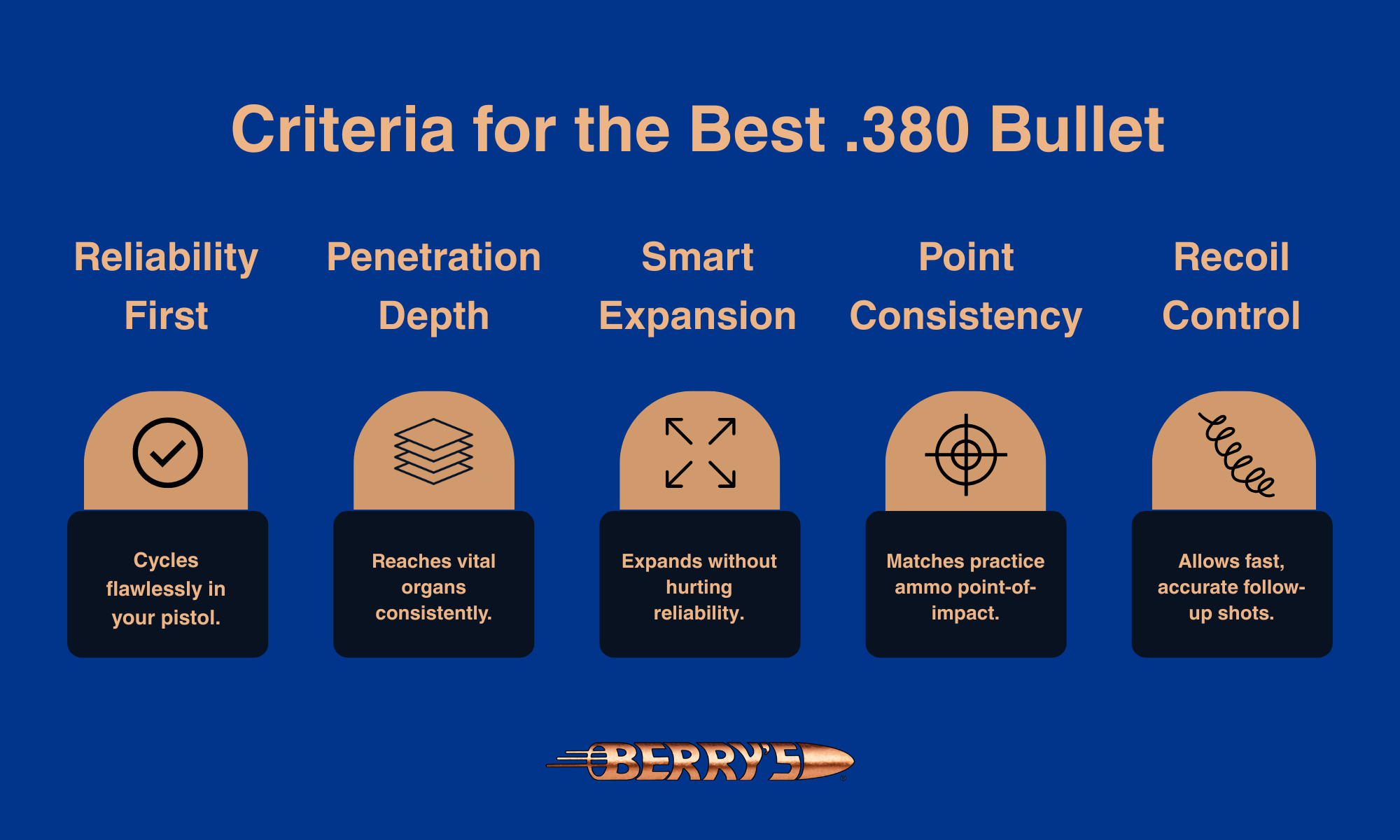
1. Reliability in Your Exact Pistol
Every pistol is different. Magazine geometry, slide speed, and feed ramp angles vary between manufacturers.
A round that cycles perfectly in your friend’s gun might cause failures in yours. Run at least 100 rounds of your defensive round through your gun before trusting it.
2. Penetration Window
Under-penetration is the most common failure mode in .380 self defense ammo. Many hollow points expand too quickly and stop short of vital organs.
3. Expansion (When It Doesn’t Break Reliability)
Expansion increases the size of the wound channel. But in the .380 ACP, it’s a bonus, not the entry ticket.
A flat point that penetrates 14 inches beats a hollow point that expands beautifully but stops at 8 inches.
4. Accuracy and Point of Impact
Your defensive round should shoot to the same point of aim as your practice ammo. A heavier bullet or lighter bullet can shift the point of impact at defensive distances. Test your carry ammo at 7 to 10 yards.
5. Recoil Control and Fast Follow-Ups
Higher velocity loads produce snappier recoil. A defensive round you can control beats one that technically performs better on paper.
Bullet Designs in .380 and What They’re Best For
Hollow Point Styles
Hollow point bullets are designed to expand on impact. The cavity at the tip catches tissue and fluid, forcing the bullet to mushroom outward.
In .380, hollow points face challenges. Many require higher velocity (900+ fps) to expand reliably. Short barrels on pocket pistols often fall below this threshold. Heavy clothing can also fill the cavity and prevent expansion. Some Critical Defense style loads use polymer tips to address this.
Round Nose vs Flat Point and Shoulder Profiles
Round nose bullets feed reliably in almost any auto pistol. Flat point and round shoulder designs offer a middle ground. They feed nearly as well but present a flatter surface on impact.
For function testing a new pistol, these profiles let you run hundreds of rounds affordably before committing to expensive hollow point ammo.
Plated vs Jacketed vs Cast
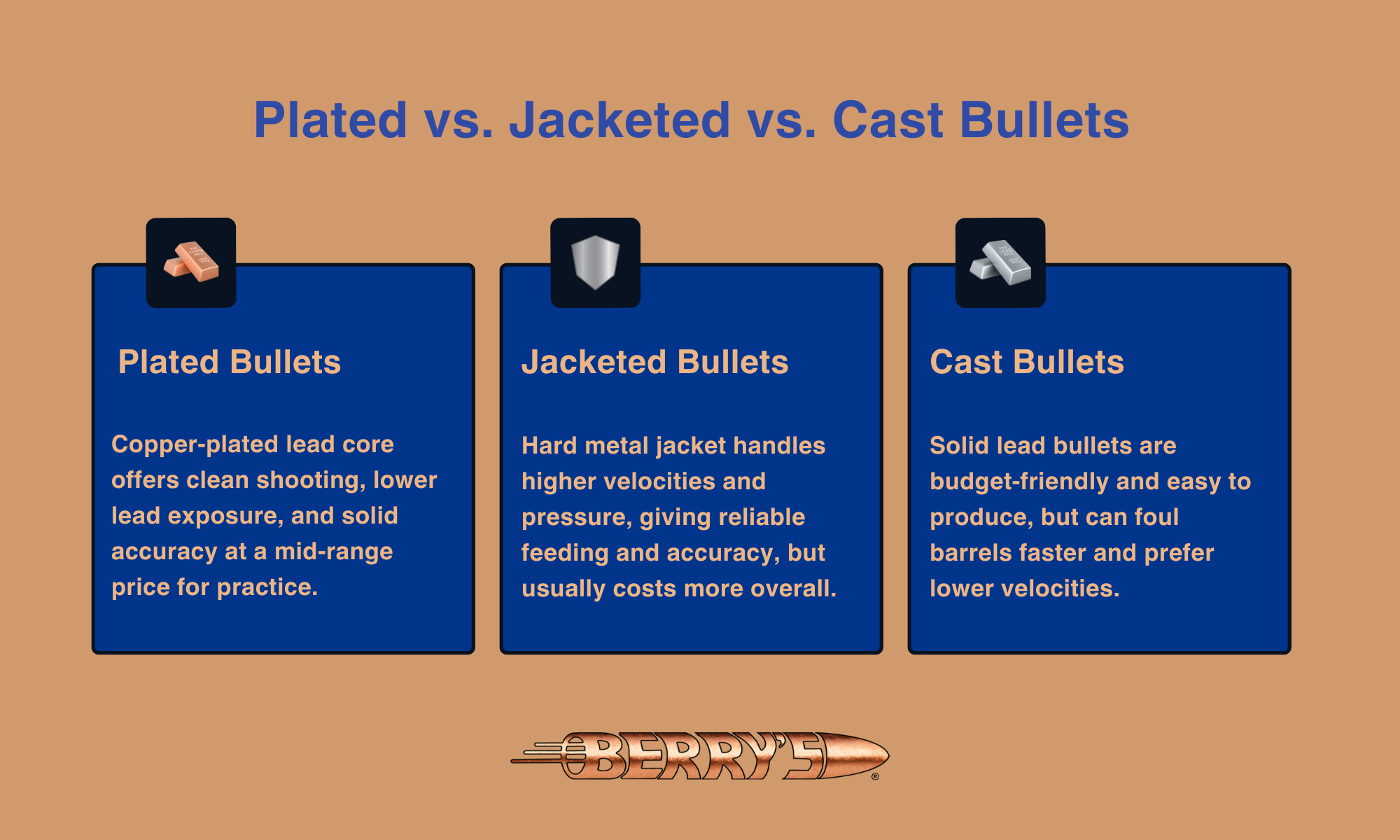
- Plated bullets: Use electroplated copper over a lead core. They produce less fouling than cast lead and cost less than full metal jacket options.
- Jacketed bullets: Use a thicker copper jacket. Full metal jacket rounds work for practice. Jacketed hollow points are standard for defensive ammo.
- Cast bullets: They are pure lead and work at lower velocities, but can lead your barrel at higher speeds.
For reloaders, consistency matters most. A plated bullet with tight weight tolerances produces more predictable results.
Berry’s .380 Bullets
For reloaders building their own .380 ACP ammunition, Berry’s offers four bullet profiles that cover practice, function testing, and defensive applications.
The .380 Cal. 100gr HHP (Hybrid Hollow Point) is the most relevant option for those wanting a self defense style bullet shape. This profile gives reloaders a hollow point design for personal protection loads using a reloadable brass case.
More .380 Bullets:
- .380 (.356) 100 gr Flat Base Round Nose works well for high-volume practice and verifying reliable feeding in a new pistol.
- .380 Cal. (.356) 100 gr Hollow Base Round Nose offers slightly different weight distribution while maintaining a smooth feed profile.
- .380 (.356) 100gr Round Shoulder offers a distinct profile that feeds smoothly and transfers energy efficiently on impact.
All four bullets share the same 100-grain weight, which simplifies load development and keeps the point of impact consistent between practice and carry configurations.
Berry’s has built a reputation over decades in the reloading community. Their copper-plated bullets start with a swaged lead core, then receive electroplated copper to reach the final weight. This process delivers tight tolerances on bullet diameter and weight.
That consistency matters when you’re testing what runs in your pistol. Fewer variables in your components means clearer answers about what works and what doesn’t.
Browse Berry’s .380 bullets here and pick the profile you want to test in your pistol.
SIGN UP FOR OUR NEWSLETTER