Your cart is currently empty!
Blog
February 09, 2026
Blog
A Complete Guide to 10mm vs .40 S&W
February 09, 2026
Table of Contents:
- 10mm vs .40 S&W: Overview
- Detailed Overview of 10mm Bullets
- Detailed Overview of .40 S&W Bullets
- Choosing Between 10mm and .40 S&W
- Why Choose Berry’s for Your Bullets
At a Glance: 10mm Auto and .40 S&W share the same bullet diameter, but they serve different shooters. A full-power load in 10mm delivers higher velocity and more energy, making it popular for outdoor use and offering a bit flatter trajectory at distance. The .40 S&W offers a balanced recoil-to-performance feel, often allowing a faster follow-up shot and more manageable practice sessions.
10mm vs .40 S&W: Overview
Brief Historical Background: 10mm vs. 40 S&W
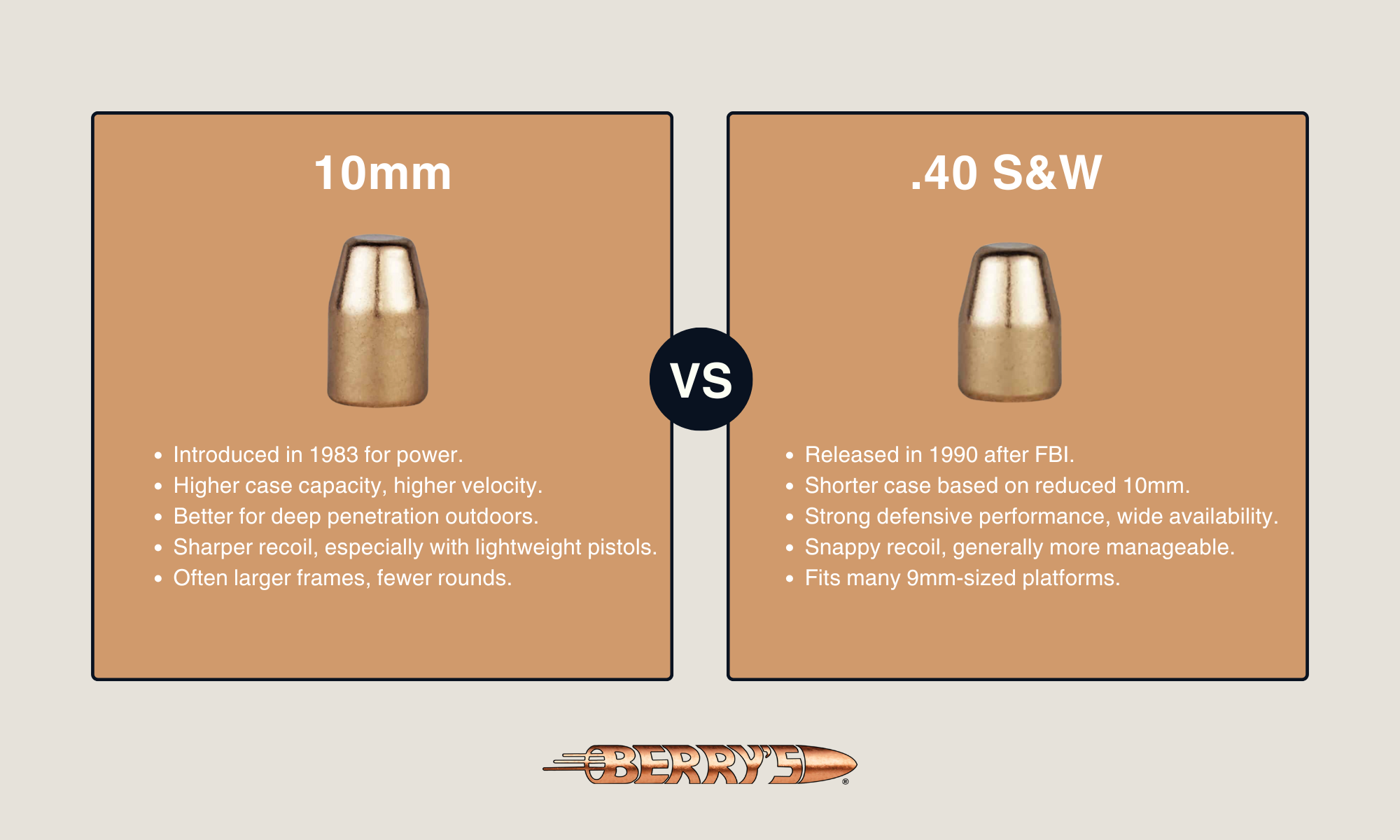
The 10mm Auto arrived in 1983 as a high velocity cartridge designed for stopping power and deep penetration. After the 1986 Miami shootout exposed limitations in existing handgun cartridges, the FBI pursued new testing that pushed them toward 10mm. However, the round’s substantial recoil led to reduced-velocity loads for qualification and duty use.
The .40 S&W emerged in 1990 as a direct response. Smith & Wesson and Winchester collaborated to match those reduced 10mm loads in a shorter case with less case capacity. The result was a cartridge with more manageable recoil that still delivered solid terminal performance for law enforcement and self defense applications.
Major Differences: 10mm vs. 40 S&W
The biggest difference between these two cartridges comes down to case capacity and velocity potential. A full-power load in 10mm can push a 180-grain bullet past 1,200 fps muzzle velocity. The .40 S&W typically tops out around 1,000 fps with a comparable bullet weight. This velocity gap translates to more energy on target with 10mm.
Recoil feel differs noticeably between the two:
- The 10mm generates sharper recoil, especially in lighter pistols
- The .40 S&W produces a snappier impulse than 9mm but remains controllable for most shooters
- This difference affects your ability to make a faster follow-up shot during strings of fire
Platform considerations matter as well. The 10mm often requires larger, heavier platforms than comparable .40 pistols. This typically means reduced magazine capacity compared to 9mm options. Popular choices include the Glock 20 and various 1911-pattern pistols. The .40 S&W fits into many compact and full-size frames originally designed for 9mm.
Effectiveness for Recreational Shooting
At the range, your choice affects both cost and comfort. The .40 S&W allows more rounds downrange before fatigue sets in. Load selection matters here. Lighter grain bullet options in both calibers reduce felt recoil and let you focus on fundamentals. Reloaders can tailor their handloads to match their specific shooting goals.
Detailed Overview of 10mm Bullets
Usage of 10mm Bullets
The 10mm shines in several distinct roles:
- Backcountry Protection: Delivers the muzzle velocity and energy needed for defense against black bear or mountain lion encounters
- Hunting: Achieves deep penetration on medium game at reasonable distances
- Range Work: Appeals to shooters who appreciate magnum revolver-level performance in a semi-auto platform
Common bullet weights for 10mm range from 155 gr to 220 gr. Lighter bullets maximize high velocity for flatter trajectories. Heavier options like the 180-grain bullet or 200 gr bullet provide better penetration on larger game. The particular round you choose depends on your intended application.
The cartridge typically uses a large pistol primer, though primer size can vary by brass manufacturer. It achieves higher velocity than most other autoloading handgun cartridges.
Are 10mm Bullets the Right Choice for You?
Consider 10mm if you need genuine stopping power for outdoor activities. The cartridge excels when deep penetration matters, whether for hunting or predator defense. Shooters comfortable with substantial recoil will appreciate the terminal performance this round delivers.
The main disadvantage involves recoil management and platform size. A larger frame pistol means more weight and potentially fewer rounds. Ammunition costs run higher than .40 S&W, though reloading helps offset this expense.
Detailed Overview of .40 S&W Bullets
Strengths of .40 S&W Bullets
The .40 S&W carved out its place in the shooting world by balancing performance with practicality. Law enforcement agencies adopted it because officers could achieve better penetration than 9mm while maintaining controllable recoil during qualifications and real-world encounters.
Popular bullet weights include 155 gr, 165 gr, and 180 gr options:
- 155 gr bullet: Higher velocity and flatter trajectory for target work
- 165 gr bullet: Balanced option for general use
- 180 gr bullet: Maximum energy transfer for self defense when loaded in defensive ammunition
The .40 S&W typically uses a small pistol primer, though this varies by brass manufacturer. This cartridge offers solid terminal performance without requiring the larger frame pistols that 10mm often demands.
Are .40 S&W Bullets the Right Choice for You?
The .40 S&W fits shooters who want more punch than 9mm without stepping up to full 10mm recoil. Pistol options abound, from compact carry guns to full-size duty weapons.
The .40 S&W works well if you:
- Already own a .40 caliber pistol
- Want a balance between capacity and power
- Prefer manageable recoil for faster follow-up shots
- Need a proven self defense cartridge
Choosing Between 10mm and .40 S&W
10mm vs .40 S&W: Key Differentiators
Recoil and Control
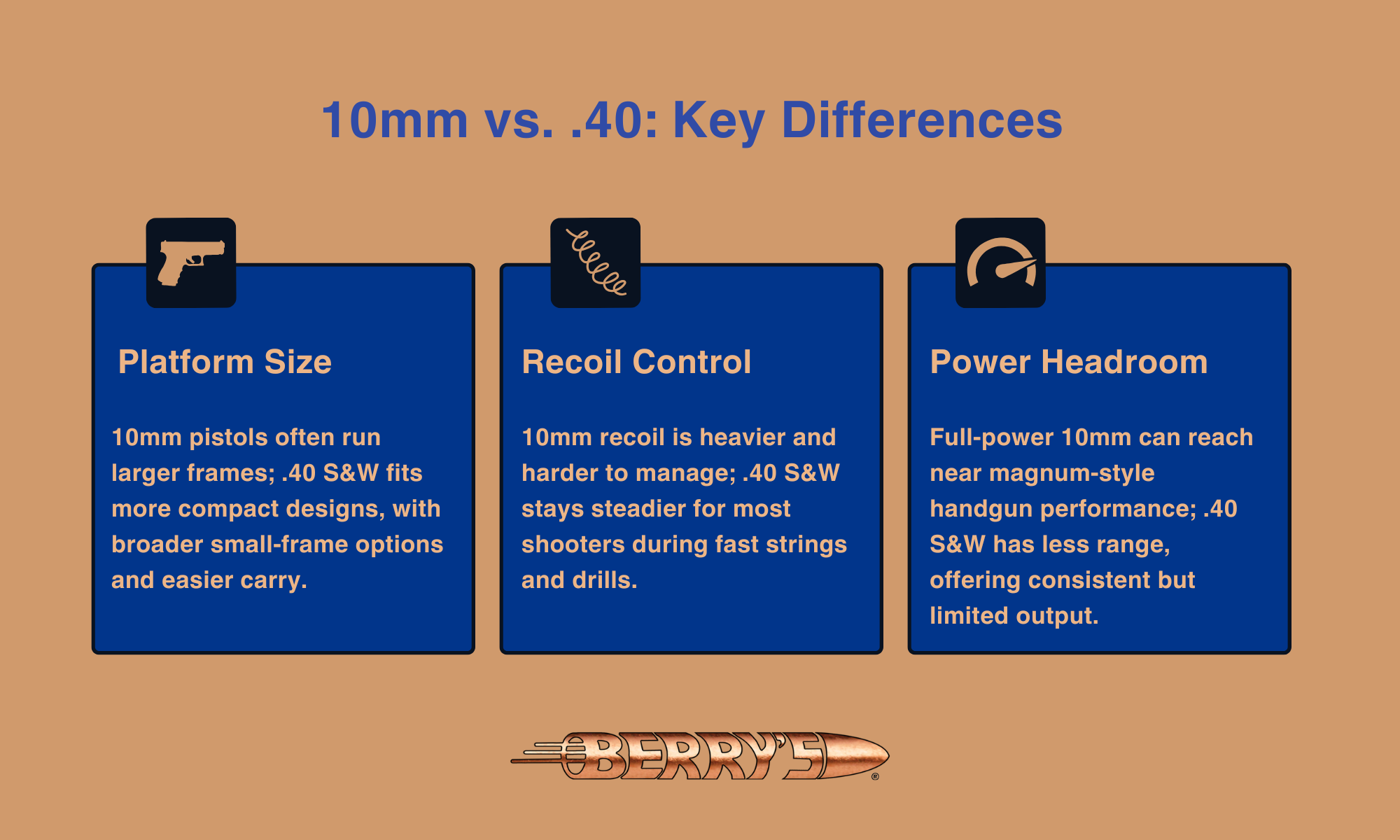
The 10mm produces notably more recoil than .40 S&W. Shot placement suffers when shooters struggle to control their pistol. The .40 S&W allows most shooters to stay on target better during rapid fire sequences.
Performance Headroom
Full-power 10mm loads approach magnum revolver-class performance in some configurations. The .40 S&W operates in a narrower performance band. If you need maximum terminal performance from a handgun, 10mm provides more headroom.
Use-Case Fit
Consider your primary application:
- Woods carry, and hunting favors 10mm
- Concealed carry and home defense work well with either
- High-volume range practice favors .40 S&W for comfort and cost
Platform Size and Capacity
The 10mm often requires larger pistols. A Glock 20 holds 15 rounds of 10mm. A comparable Glock 22 holds 15 rounds of .40 S&W in a slightly smaller package. Compact options exist for both, but .40 S&W offers more variety in smaller frames.
The Verdict: It Comes Down to Personal Preference
Both cartridges deliver solid performance for their intended purposes. The 10mm excels when you need maximum power from a semi-auto handgun. The .40 S&W provides a balanced option that works across multiple applications.
Simple decision framework:
- Choose 10mm for outdoor adventures and hunting
- Choose .40 S&W for everyday carry and range work
- Test both before committing to either platform
The best cartridge is the one you shoot well. Rent or borrow pistols in both calibers before making your decision.
Why Choose Berry’s for Your Bullets
Berry’s manufactures superior plated pistol bullets trusted by reloaders across the shooting world. Our copper plating process starts with a swaged lead core, then electroplates copper to reach the final weight. This delivers zero lead exposure and consistent quality control batch after batch.
Our .40/10mm bullet lineup includes multiple weights and profiles:
- 155 gr, 165 gr, 180 gr, 200 gr, and 220 gr options
- Flat point, round nose, hollow point, and round shoulder profiles
- Thick plate options for higher velocity loads
Shop Berry’s .40 S&W and 10mm Bullets
SIGN UP FOR OUR NEWSLETTER
