
Your cart is currently empty!
Blog
March 12, 2026
Blog
How to Start Reloading Ammo: A Beginner’s Guide
March 12, 2026
Table of Contents:
- Why Reload Your Own Cartridges?
- Reloading Basics and What You’re Building
- What You Need to Get Started
- Step-by-Step: Your First Reloading Session
- How to Use Load Data Correctly
- Common Beginner Mistakes and How to Avoid Them
- Build Your Reloading Bench with Berry’s Bullets and Reloading Supplies
Short Answer: Reloading ammo means assembling cartridges using brass, primers, powder, and bullets. Start by learning the basic steps, buying the right equipment, and following published load data for your caliber and bullet weight. Work slowly, measure carefully, and inspect every round. Safe habits matter more than speed.
Why Reload Your Own Cartridges?
One of the most common questions newer shooters ask is whether reloading is actually worth the effort. The short answer is control. Reloading lets you tune powder charges, bullet weights, and seating depths to match your specific rifle. Factory ammunition is built to function across thousands of firearms, which means it is rarely optimized for one. Reloaders also reduce dependence on shelf ammo availability, which matters during supply shortages. If you shoot often or need consistent results, reloading lets you build around your firearm and your goals.
Reloading Basics and What You’re Building
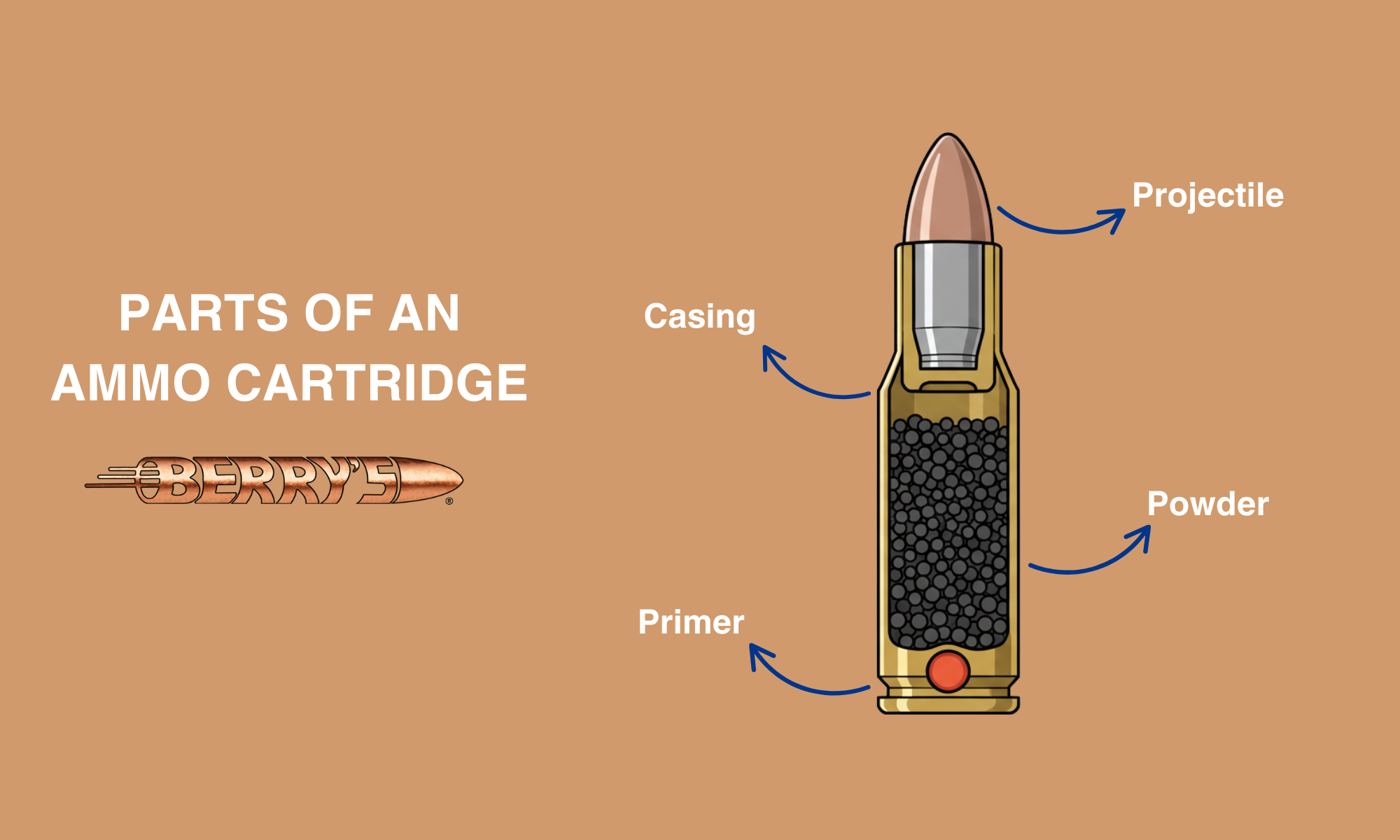
A finished cartridge has four parts. Every step of the reloading process exists to assemble those parts safely. Published load data is your rulebook.
The 4 Parts of a Cartridge
Every round starts with a shell casing (the brass case that holds everything together). A primer sits in the base and ignites the powder charge when struck. The powder burns to create pressure. The bullet sits at the mouth and is what leaves the barrel.
What “Load Data” Means
Load data gives you tested charge ranges, powder types, and cartridge overall length (COAL) for specific bullet weights and styles from controlled testing by powder and bullet manufacturers. Never substitute components based on assumptions.
What You Need to Get Started
Focus on the tools and components for your first batch, then add reloading gear as your needs grow.
Core Tools
A single-stage press is the most common recommendation for beginners. A turret press or progressive press can speed things up later, but a single-stage reloading press handles one step at a time.
Beyond the press, you will need:
- Resizing die set for your caliber
- Shell holder for your cartridge
- Powder measure and powder funnel
- Powder scale (a beam scale works, though a digital scale is faster)
- Dial caliper for measuring case length and COAL
- Loading block to hold cases upright
- Hand priming tool for seating primers off-press
- A reputable manual (the Lyman Manual is a popular starting point)
A beginner reloading kit bundles several of these items and saves money upfront.
Core Components
You need brass, primers, powder, and bullets. Match caliber, bullet weight, and powder type to published load data. New brass is consistent, but once-fired brass works if properly inspected.
Setting Up a Safe Reloading Workspace
A clean, well-lit bench prevents mistakes. Minimize distractions and label every batch with the load details.
Simple Bench Rules That Prevent Mistakes
- One powder on the bench at a time
- One primer type per session
- Label everything clearly
- If interrupted mid-step, stop and verify where you left off. Re-check all cases, especially any that may already hold a powder charge
Safety and Legal Note
Follow your reloading manual and local laws. If unsure about any step, ask an experienced reloader or visit a trusted local shop.
Step-by-Step: Your First Reloading Session
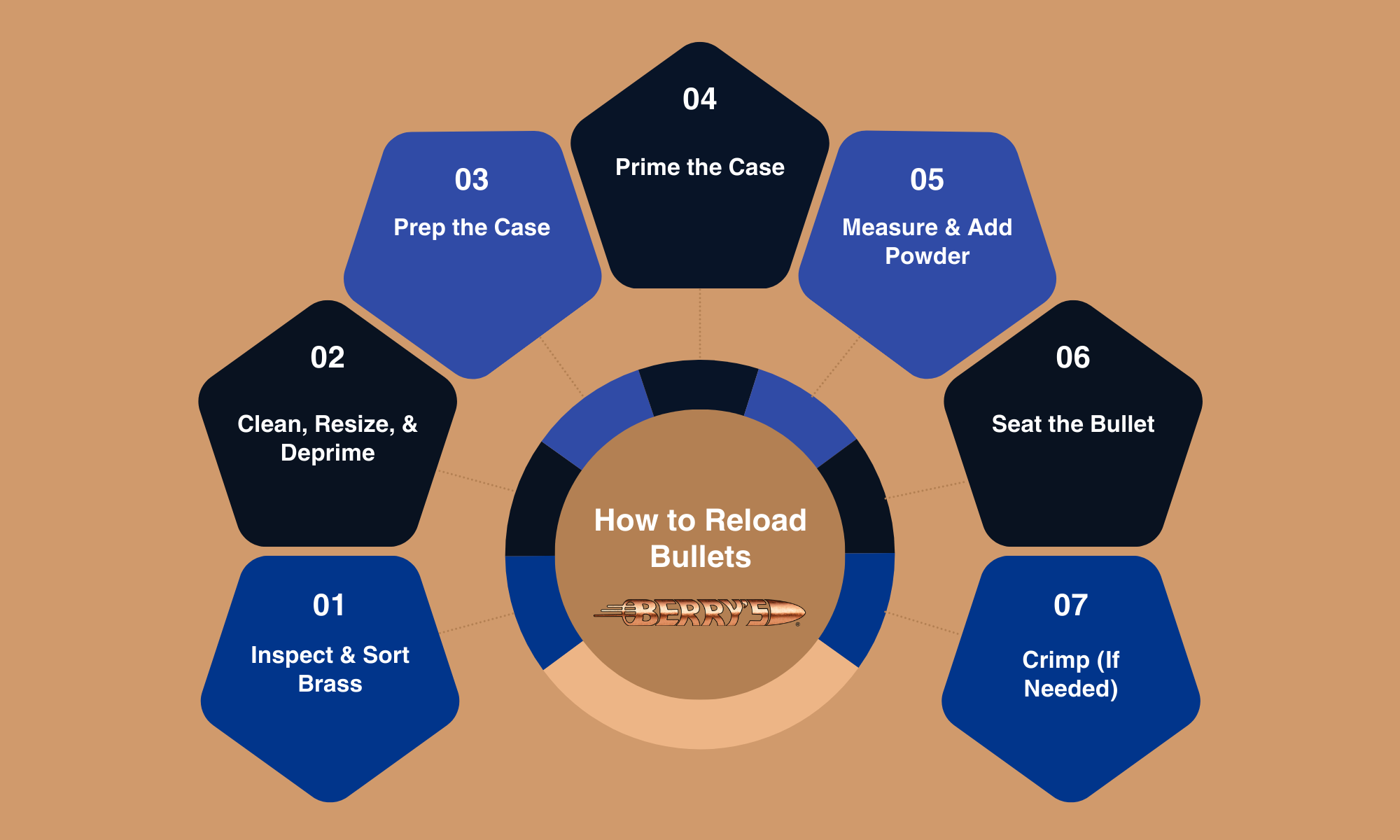
Step 1: Inspect and Sort Brass
Sort brass by caliber. Sorting by headstamp is optional but improves consistency since case volume and neck tension vary between manufacturers. Check each empty case for split necks, cracks, bulges, and loose primer pockets.
Step 2: Clean, Resize, and Deprime
Dirty cases hide defects. Run brass through a case tumbler or case cleaner first. The right media and polish removes carbon and makes inspection easier.
A resizing die returns brass to proper dimensions. Rifle reloaders typically use a full-length resizing die. Pistol dies also resize, but the term “full length” is mainly used in rifle contexts. Rifle brass and non-carbide pistol dies need case lube. Depriming pushes the spent primer out during the same stroke.
Step 3: Prep the Case If Needed
Rifle brass stretches and may need trimming. Use a case trimmer to bring the case length back into spec, then chamfer the case neck.
Clean primer pockets with a primer pocket cleaner if needed. If working with crimped military brass, swage or ream the crimp before a new primer will seat. This is a common stumbling point during case prep.
Step 4: Prime the Case
Seat each new primer flush to slightly below flush. Watch for upside-down or crushed primers, and primers that seat too easily (worn pockets). Keep primer type consistent within a batch.
Step 5: Measure and Add Powder
Set your powder measure or powder dispenser and verify throws on a powder scale. Start at the recommended starting load from published data. A consistent powder charge across every case is the goal.
Step 6: Seat the Bullet and Set Overall Length
Set seating depth using a dial caliper and the manual’s tested COAL for your specific bullet. COAL changes with bullet profile, even at the same weight. Do not copy COAL from a different bullet design.
Step 7: Crimp (Optional)
Some loads need a crimp to prevent bullet setback. Many semi-auto pistol cartridges headspace on the case mouth and use a taper crimp rather than a roll crimp. Using the wrong type can cause feeding issues and pressure changes. Follow your manual and die instructions.
How to Use Load Data Correctly
Match Bullet Weight and Style to the Data
Use data matching your bullet weight and type as closely as possible. Small differences in bullet design can change seating depth and pressure.
Start Low and Work Up in Small Steps
“Working up” means starting at the minimum powder charge and increasing in small increments. Track charge weight, COAL, primer type, brass, and range results. This is load development.
Quality Checks Before You Shoot
Visual Checks and Feel Checks
Look for high primers, bulges, cracked cases, and inconsistent seating depth. If a round feels different from the batch, set it aside.
Gauge or Fit-Check
Use a case gauge to confirm sizing and overall fit. If you use the firearm as a check, make sure it is unloaded with the magazine removed in a safe area away from your loading bench.
Common Beginner Mistakes and How to Avoid Them
The “Slow Down” List
- Double charges: Visually inspect every case before seating bullets
- Wrong powder: One powder on the bench at a time
- Mixed brass: Sort by headstamp and caliber before starting
- Inconsistent COAL: While learning, measure every round. Spot-checking works later, but start by verifying each one
- Skipping measurements: A powder scale and dial caliper are not optional
When to Stop and Pull Bullets
If anything feels off, stop. Use a bullet puller to disassemble the round and start over. A bullet puller is an essential tool in any reloading setup.
Next Steps: Building Consistency Over Time
Accurate ammo comes from repeatable processes. Once a load works, reproduce it every time.
What to Track in a Load Log
Record powder type, charge weight, COAL, primer, brass, date, firearm, and range notes. This becomes your reference for every future session.
Change One Thing at a Time
Adjust one variable per test. If you change the powder charge and bullet at the same time, you will not know which caused the difference.
Build Your Reloading Bench with Berry’s Bullets and Reloading Supplies
Choose Berry’s Plated Bullets by Caliber, Weight, and Profile
Once you are comfortable with the process, pick bullets that match your load data and your intended use. Berry’s Superior Plated Bullets cover popular handgun and rifle calibers with multiple grain weights and profiles, making it easier to align your bullet choice with your manual’s tested data.
In times of ammo shortage, having your own ammo supply on the bench means you are not waiting on factory ammo restocks to get to the range.
Whether you are loading plinking rounds or building accurate ammo for competition, Berry’s has options to fit your needs.
Stock Up on Berry’s Reloading Supplies That Support Each Step
Berry’s also offers reloading supplies designed to support your full bench workflow:
- Case lube for smooth sizing
- Primer flip trays for efficient priming setup
- Powder funnels for clean charging
- A bullet puller for correcting mistakes without wasting components
For case prep, Berry’s carries brass cleaning solutions, including tumblers, media, polish, and separators to handle dirty cases. Finish with an ammo box or ammo cans to label, store, and protect your finished rounds.
Stock up on what you need and load your own ammo with confidence.
SIGN UP FOR OUR NEWSLETTER