
Your cart is currently empty!
Blog
March 12, 2026
Blog
Handloading Rifle Ammunition: A Beginner-Friendly Step-by-Step Guide
March 12, 2026
Table of Contents:
- What Handloading Is and Why Rifle Shooters Do It
- Safety Rules You Don’t Skip
- Tools and Gear for Rifle Handloading
- Understanding Load Data for Rifle Cartridges
- Step-by-Step: Handloading Rifle Ammo
- Get Set Up with Berry’s Bullets and Reloading Gear
Short Answer: Handloading rifle ammo is the process of assembling cartridges with brass, primers, powder, and bullets using published load data. You clean and size brass, prep it to spec, seat primers, measure precise powder charges, and seat bullets to the correct overall length. Go slow, follow manuals, and inspect everything.
What Handloading Is and Why Rifle Shooters Do It
Handloading gives you control over every part of the cartridge you fire. Instead of relying on factory ammo, you build each round from components matched to your specific rifle.
- Better consistency. Tuned loads can improve rifle accuracy and help you chase sub-MOA groups.
- Keeping uncommon rifles fed. When commercial ammunition is scarce, handloading keeps older cartridges alive.
- Repeatability. Once you develop a load, you reproduce it on demand instead of hoping your factory load stays in stock.
The Four Components of a Rifle Cartridge
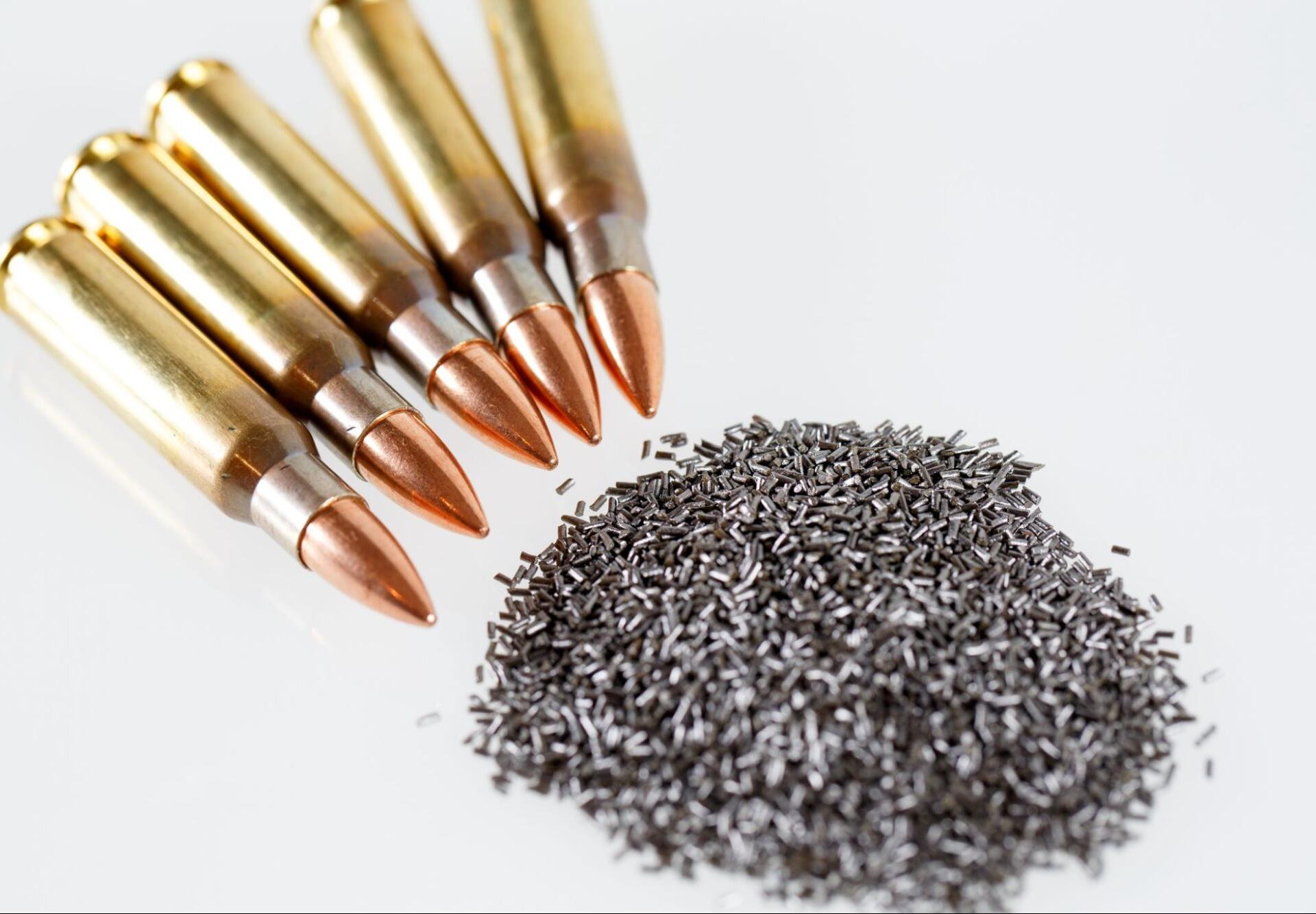
Every rifle cartridge has four parts. The brass case holds everything together. A primer in the base ignites when struck. Smokeless powder generates pressure. The bullet seats at the mouth and travels down the barrel.
When Handloading Makes the Most Sense
Handloading pays off most when factory ammunition does not meet your needs. That includes oddball calibers, precision rifle work where you want maximum accuracy, hunting loads for a specific rifle, and times of ammo shortage.
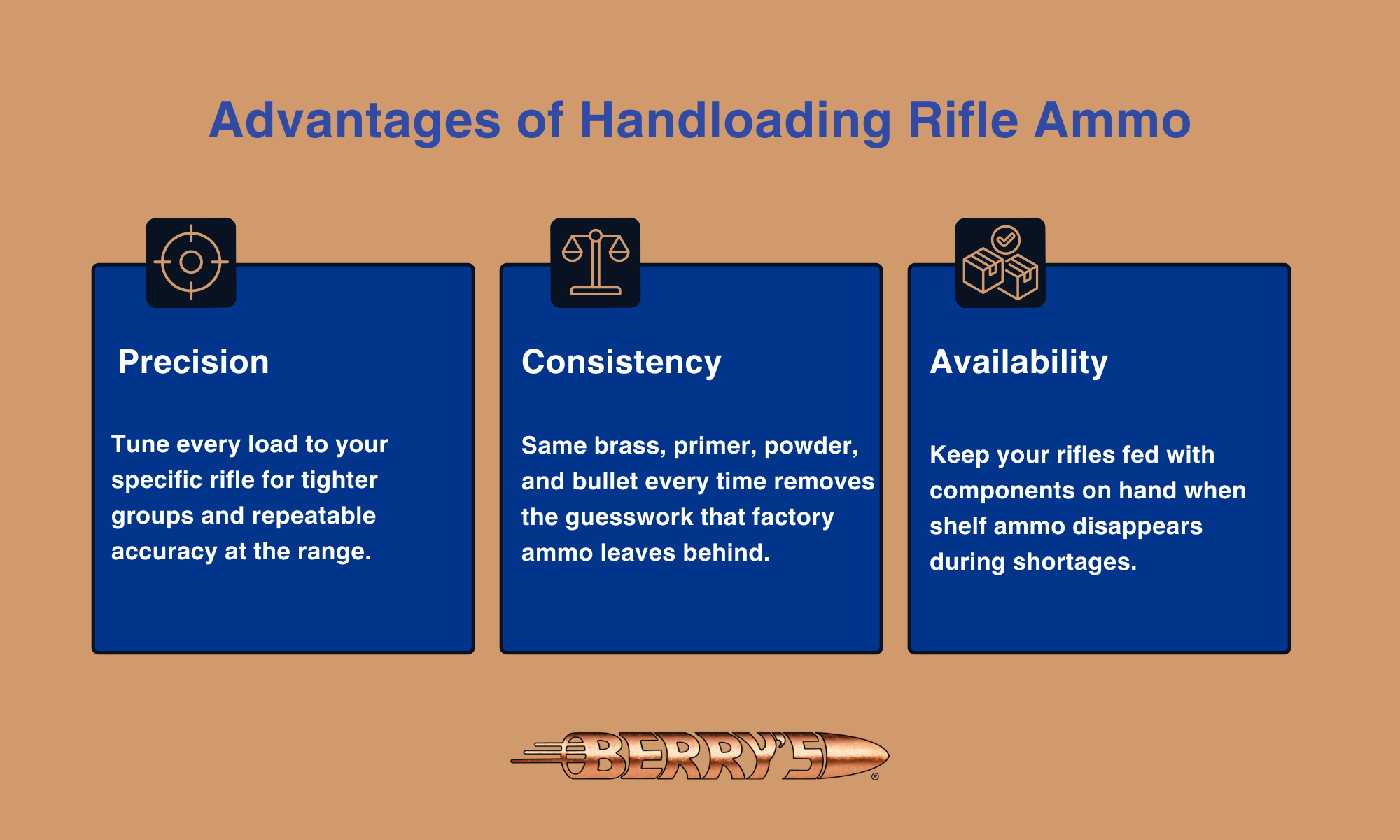
Handloading rifle ammunition offers improved precision, consistency, and better availability during shortages.
Safety Rules You Don’t Skip
The reloading process demands attention. Follow published load data from a reloading manual and match components as closely as possible. If you substitute anything, restart at the minimum charge and work up.
Powder and primers should be labeled and stored separately. Never have more than one powder type on the bench.
The “One Variable at a Time” Rule
During load development, change only one thing per test. Adjust the powder charge or seating depth or primer, but not all three. That is the only way to know what affected the result.
Preventing the Two Big Mistakes
The two most common dangerous errors are wrong powder and incorrect charge weight, whether an overcharge or a missed charge. Keep one powder on the bench and do a visual inspection of every charged case in the loading block before seating bullets.
Tools and Gear for Rifle Handloading
You do not need every piece of reloading equipment at once. Start with the basics and upgrade over time.
Core Equipment List
A single-stage press is the best starting point. A turret press or progressive press can come later, but a single-stage reloading press keeps you focused. Your core setup includes:
- Rifle die set (full-length sizing die + seating die)
- Shell holder
- Case lube
- Powder measure and powder scale
- Calipers for case length and COAL
- Case trimmer
- Chamfer/deburr tool
- Loading block
- At least one reloading manual
Nice-to-Have Upgrades
Not required for your first session, but these make the reloading process smoother over time:
- Vibratory tumbler or wet tumbler for cleaning brass
- Case gauge or headspace comparator
- Powder trickler or dispenser for precise charges
- Hand-priming tool for a better feel when seating primers
- Chronograph for load testing and velocity tracking
Understanding Load Data for Rifle Cartridges
Load data tells you what goes into a safe round. It lists powder type, start and max charges, COAL, primer type, and bullet weight. Rifle cartridges operate at high pressures, and small changes in powder charge or seating depth can make a big difference.
Bullet design matters even at the same grain weight. Two bullets with the same weight but different profiles require different seating depths and produce different pressures.
Matching Your Bullet to the Data
The same weight does not mean the same profile. A 168-grain boat tail and a 168-grain flat base need different seating depths because they displace different internal case volume. Use data that matches your bullet as closely as possible.
Start Loads vs Max Loads
Start at the minimum listed powder charge and work up in small increments. Watch for pressure signs at every step. Never jump to a max load with an untested combination.
Step-by-Step: Handloading Rifle Ammo
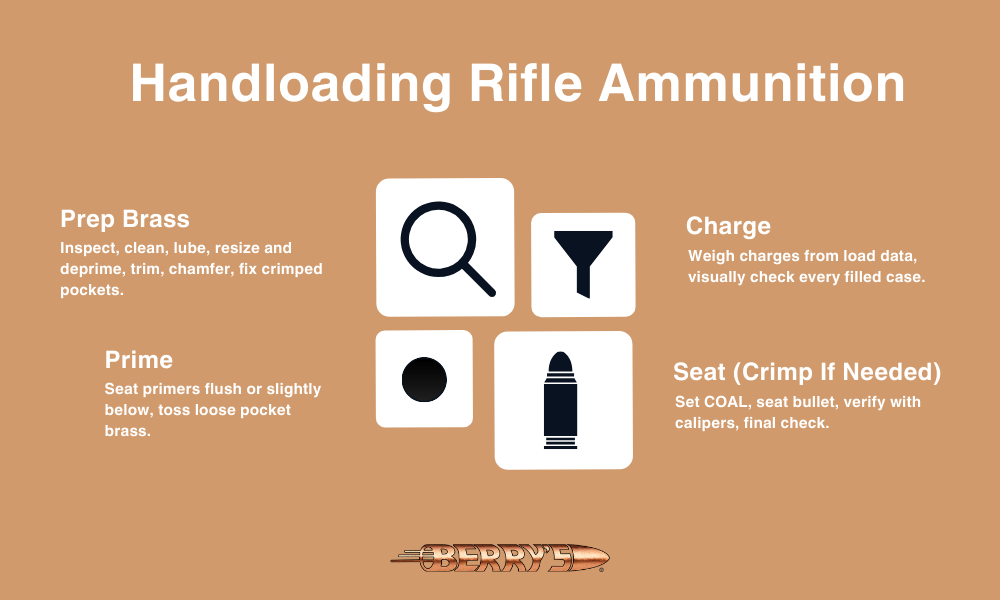
A step-by-step overview of the rifle ammunition handloading process.
Step 1: Inspect and Sort Brass
Sort brass by caliber. Sorting by headstamp is optional but improves consistency since cartridge case dimensions vary between manufacturers. Check each piece of empty brass for cracks, split necks, stretch marks, loose primer pockets, and dents.
Step 2: Clean Brass So You Can See Problems
Dirty brass hides defects and wears on your dies. Tumble or wet-clean your brass, then dry completely before moving on.
Step 3: Lube and Full-Length Resize, Then Deprime
Apply case lube before sizing. Skipping lube on rifle brass can stick a case in your die. Full-length sizing returns the brass case to factory dimensions. Depriming happens during the same stroke. Neck sizing works for bolt-action rifles, but full-length is the safer starting point.
Step 4: Measure Case Length, Trim If Needed
Rifle brass stretches after firing. Use a case trimmer and your reloading manual’s specs to bring each case back to the correct length.
Step 5: Chamfer and Deburr the Case Mouth
After trimming, the case mouth can have rough edges. Chamfering and deburring helps new bullets seat smoothly without shaving copper.
Step 6: Primer Pocket and Flash Hole Prep (Optional)
Only needed in certain situations. If working with crimped military brass, swage or ream the primer pocket before priming. Otherwise, a quick debris check is enough.
Step 7: Seat Primers Correctly
Seat each primer flush to slightly below flush. Watch for crushed primers or primers that seat too easily, which can signal a problem with the pocket.
Step 8: Measure and Add Powder Charges
Set your powder measure and confirm throws on the scale. Use a funnel and keep powder type consistent. Before seating bullets, do a visual inspection of every charged case in the loading block.
Step 9: Seat the Bullet and Verify COAL
Set seating depth with calipers using the COAL from your load data. Do not copy COAL from a different bullet. Some bullets sit deeper depending on profile, even at the same weight.
Step 10: Crimp (Usually Not Needed for Many Rifle Loads)
Most rifle rounds do not require crimping. Neck tension from a properly sized case usually holds the bullet. Crimp only if your load data or die setup calls for it.
Final Checks Before You Shoot
A quick check of finished rifle rounds catches problems before they reach the chamber.
Simple Visual + Feel Checks
Look for high primers, neck damage, bulges, and inconsistent seating depth. If anything looks different from the rest of the batch, set it aside.
Case Gauge or Rifle Fit-Check
A case gauge is the cleanest way to verify sizing and overall fit. If using the rifle chamber as a check, make sure the firearm is unloaded in a safe area with no ammunition on the bench.
Building a Repeatable Load Over Time
Load development turns a working load into a reliable one. It builds through careful notes and controlled changes over multiple range trips.
What to Record in a Load Log
Track bullet, brass, primer, powder, powder charge, COAL, date, rifle used, and results. This log is your reference for every future batch.
How to Work Up Safely
Increase charges in small increments. Watch for pressure indicators such as hard bolt lift, ejector marks, unusual case head swipe, or primers that look abnormal compared to your baseline. No single sign is proof by itself. If uncertain, stop.
Get Set Up with Berry’s Bullets and Reloading Gear
Pick Berry’s Bullets That Match Your Caliber and Goal
Every Berry’s rifle bullet starts as a swaged lead core and is copper-plated to its final weight for consistent performance. With over 60 years of manufacturing experience and full in-house production, Berry’s delivers the accuracy and reliability handloaders demand.
Berry’s carries rifle bullets across eight options to match your caliber and your goal:
- .223/5.56mm 55gr FMJ-BT: A jacketed boat-tail built for flat trajectory and reliable feeding in AR-platform rifles.
- .223/5.56mm 62gr FMJ-BT: A heavier jacketed option with a higher ballistic coefficient for improved performance at distance.
- .300 Blackout: Available in 150gr, 180gr, 200gr, and 220gr spire points for supersonic and subsonic loads.
- 30 Carbine 110gr Round Nose: A plated round nose designed to keep classic M1 Carbines fed and running.
- 30-30 150gr Round Shoulder: A lever-gun favorite built for reliable feeding and consistent hunting performance.
- 7.62x39mm 123gr Spire Point: A plated spire point that gives AK and SKS shooters a dependable handloading option.
- 45-70 350gr Round Shoulder: A heavy hitter for big-bore lever actions and single shots.
- .458 SOCOM 350gr Round Shoulder: Built for AR-platform big-bore setups where factory ammo options are limited.
Add the Small Tools That Make Rifle Handloading Smoother
Berry’s carries reloading gear designed to support every step at the bench:
- Case lube for smooth resizing
- Powder funnels for clean charging
- Primer flip trays for organized priming
- A bullet puller for correcting mistakes without wasting components
For cleaning, Berry’s offers tumblers, media, polish, and separators. For storage, grab ammo boxes and cans to label and protect your finished rifle rounds.
SIGN UP FOR OUR NEWSLETTER