
Your cart is currently empty!
Blog
September 13, 2026
Blog
How Fast Does a Bullet Travel?
September 13, 2026
Short Answer: Most bullets travel between roughly 1,000 and 3,000 feet per second (fps) when they leave the barrel, and some high-velocity rifle rounds move even faster. That leaving-the-barrel figure is called muzzle velocity. A bullet reaches its top speed at the muzzle and slows down over distance as air resistance and gravity act on it. The exact speed depends on the cartridge, the bullet weight, the barrel length, and the bullet shape.
How Fast Does a Bullet Travel?
There is no single answer, because bullet velocity varies widely by cartridge and firearm. Speed is measured in feet per second (fps).
For example, Berry’s lists the following velocity limits for specific bullets:
- 9mm 115gr Round Nose: Maximum velocity of 1,250 fps.
- .300 Blackout 220gr Spire Point: Maximum velocity of 1,300 fps with a 1:7 twist barrel, or 1,000 fps with a 1:5 twist barrel.
- .30-30 150gr Round Shoulder: Maximum velocity of 2,000 fps.
- 7.62 x 39mm 123gr Spire Point: Maximum velocity of 2,000 fps.
Actual muzzle velocity varies by ammunition load, bullet weight, and barrel length. To put those numbers in everyday terms, 1,000 fps is about 682 miles per hour (mph), and 3,000 fps is over 2,000 mph. Even the slowest common bullet is moving faster than almost anything you see on the ground.
What Is Muzzle Velocity?
Muzzle velocity is the speed of the bullet at the instant it leaves the muzzle (the front end of the barrel). It is the fastest point in the bullet’s flight, so it serves as the baseline for everything that happens downrange.
The listed muzzle velocity printed on a box of ammunition is measured under standardized industry test conditions with a specific barrel length. Your firearm may produce a different number. Barrel length, temperature, and the specific load all shift the real figure, so treat the listed muzzle velocity as a reference rather than a guarantee.
What Happens Inside the Cartridge
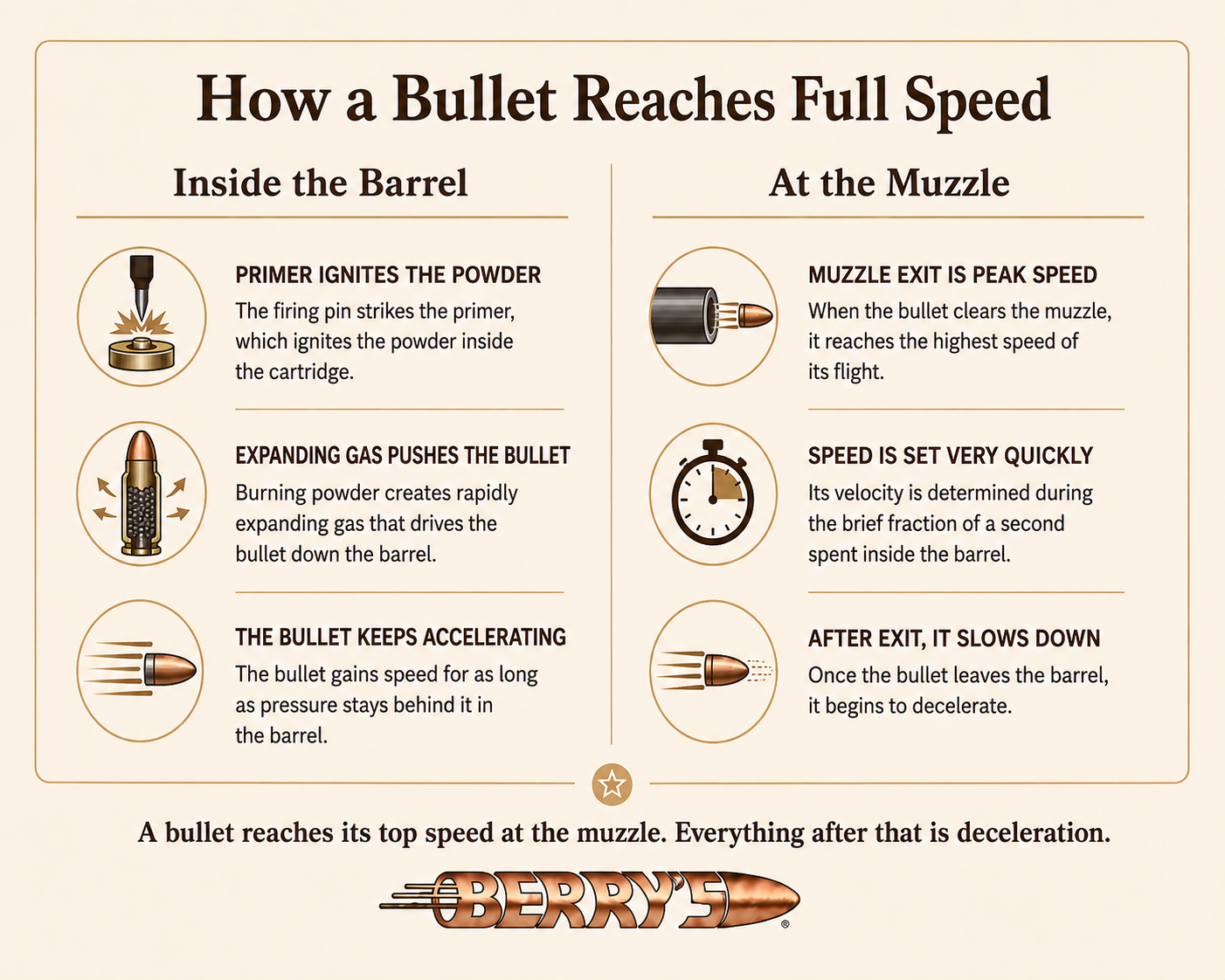
The speed of a bullet is set in the fraction of a second it spends inside the barrel. When the firing pin strikes the primer, the primer ignites the powder packed inside the cartridge. The burning powder produces rapidly expanding gas that pushes the bullet down the barrel. The bullet keeps accelerating for as long as that pressure stays behind it. At bullet exit, the point where it clears the muzzle, it reaches its top speed for the entire flight. Everything after that point is deceleration.
What Affects How Fast a Bullet Travels
Several factors decide where a given round lands in the velocity range.
Barrel Length
A longer barrel gives the powder more time to burn and push the bullet before it exits. Up to a point, more barrel length means more velocity. Past that point, friction and falling pressure cancel out the gain. This is why the same cartridge fired from a rifle and from a short-barreled pistol produces very different speeds, and why the length of the barrel is one reason a listed muzzle velocity may not match what you measure.
Bullet Weight
Bullet weight is measured in grains. Within the same caliber and powder charge, a heavier round generally leaves the barrel slower than a lighter one, because the powder has more mass to accelerate. A lighter bullet can reach a higher muzzle velocity, though it may shed speed faster once it is in the air.
Bullet Shape and Ballistic Coefficient
A bullet’s shape controls how cleanly it cuts through air. Ballistic coefficient (a number that describes how well a bullet resists air resistance) captures this in a single value. A higher ballistic coefficient means the bullet holds its velocity better over long distances. A sleek, pointed bullet arrives at the target with more of its speed intact than a flat or round-nosed bullet fired at the same starting velocity.
Cartridge and Powder Charge
The cartridge and its powder charge set how much pressure builds behind the bullet. More energy pushing the projectile means more speed, within the safe pressure limits established by published load data. Two cartridges can even share the same bullet diameter and still reach very different velocities, as the .357 Magnum and .38 Special comparison shows.
Why a Bullet Slows Down
Once the bullet leaves the muzzle, two forces begin working against it: air resistance and gravity.
Air resistance, or drag, is the main brake on bullet travel. The bullet pushes through air the entire way to the target, and that friction bleeds off speed continuously. Barometric pressure and air density change how much drag the bullet meets. Thinner air at higher elevation slows the bullet less than dense air at sea level. Wind speed is a factor too, pushing the bullet off course and adding to or subtracting from its forward speed.
Gravity pulls the bullet toward the earth from the moment it clears the muzzle. Gravity does not reduce the bullet’s forward speed much, but it curves the path downward, which is why shooters hold higher for targets at long distances. Over a mile, a bullet can lose a large share of its starting velocity, so the speed of a bullet at the target is always lower than its muzzle velocity.
How Bullet Speed Compares to the Speed of Sound
According to NASA, the speed of sound at sea level is about 1,100 to 1,125 feet per second (roughly 760 to 767 mph), varying with temperature. Many rifle bullets travel well above this and are supersonic, which is what creates the sharp crack you hear at the range. Other rounds, and most air rifle pellets, stay below the speed of sound and are subsonic. A standard rifle bullet leaving the barrel at 3,000 fps is moving over 2,000 mph, far faster than a speeding car or a passing plane.
Why Bullet Speed Matters
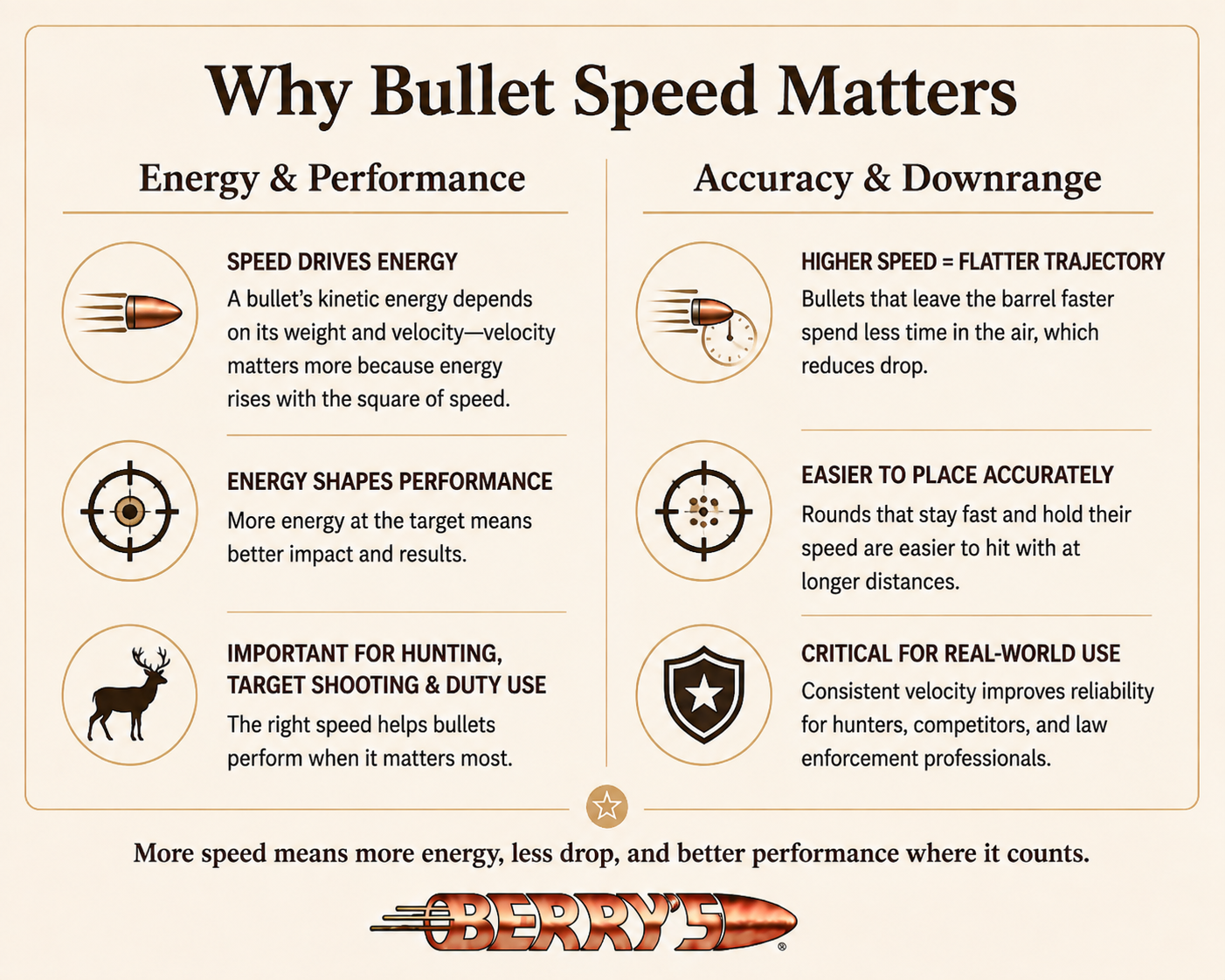
A bullet’s speed determines how much energy it delivers and how it behaves over distance. Kinetic energy (the energy an object carries because it is moving) depends on both bullet weight and velocity, and velocity counts more because the energy rises with the square of the speed. That energy shapes how a bullet performs when it reaches the target.
Velocity also affects accuracy and drop. A round that leaves the barrel fast and holds its speed well is easier to place accurately over long distances. This matters for target shooting, for hunting, and for the duty rounds used by law enforcement across the United States.
Control Your Own Velocity with Berry’s Bullets
If you reload, you control several of the factors that set bullet velocity. Choosing your bullet weight, matching your components to published load data, and working up a load lets you dial in the speed and consistency your firearm needs.
Berry’s Superior Plated Bullets come in popular handgun and rifle calibers across multiple grain weights and profiles, so you can match your bullet choice to your load data and your intended use, whether that is steady plinking rounds or accurate ammo for competition. Because plated bullets perform best below magnum speeds, Berry’s lists a recommended maximum velocity for every bullet, which makes it easy to keep your load in a safe, accurate range. Consistent bullet weight and shape from round to round also help keep your velocity predictable shot after shot.
Berry’s also carries the reloading accessories, brass cleaning supplies, and ammo boxes that support the rest of your bench, from case prep through storage. If you are setting up or refining your station, these reloading bench organization ideas can help you build a smarter workflow. Pick the components that fit your caliber and build rounds you can rely on.
Always follow your reloading manual and published load data, and check your local laws before you load.
SIGN UP FOR OUR NEWSLETTER